The Hotel Room Is the Most Underrated Aphrodisiac
Why a change of sheets changes everything, and the details that make a suite worth the rate.

Your bedroom has a lot going for it. It’s free, the pillows are broken in exactly the way you like, and nobody charges you for the minibar. It also has a laundry basket in the corner, a phone charger on the nightstand that you plug in every night at 11:40, and a door that opens onto a hallway full of everything you still haven’t done this week. The room remembers all of it, and so do you.
A hotel room remembers nothing. That’s the whole pitch. Someone else made the bed with corners you couldn’t replicate under oath, the towels are a color you’d never buy, and the only chore within reach is deciding which side of the bed is yours tonight. What’s newer is that relationship researchers have spent the last 25 years putting numbers on why a change of scenery seems to work, and the numbers are more interesting (and more modest) than the travel brochures suggest.
What follows is the evidence, read honestly, and then a practical playbook: which room features are worth paying for, the questions to ask before you hand over a card, what goes in the bag, and how to get most of the effect on a one-night budget.
The short version: Studies on couples doing new, slightly exciting things together link novelty to higher relationship satisfaction and, in one 2019 paper, higher sexual desire. A hotel helps because it strips out the household cues that run your routine at home. Pay for quiet, darkness and a proper bath; skip the view and the champagne package. Ask about the room next door, the elevator, late checkout and the do-not-disturb policy before you book. One night across town gets you most of the way there.
What the research on novelty actually says
The study everyone cites is Arthur Aron and colleagues’ 2000 paper in the Journal of Personality and Social Psychology. It’s worth knowing what they actually did, because it’s stranger than the headline. Across a newspaper questionnaire and a door-to-door survey, couples who reported doing more “exciting” things together also reported higher relationship satisfaction, and the link ran partly through lower relationship boredom. Then came three lab experiments. Some couples were strapped together at the wrist and ankle with Velcro and asked to get a pillow across a barrier without using their hands, arms or teeth. Others did a duller version of a shared task. The novel, mildly ridiculous seven-minute task produced bigger before-to-after gains in how couples rated their relationship, and outside observers rating videotaped conversations picked up the same shift.
Seven minutes, Velcro and a pillow. If that moves the needle, a night somewhere unfamiliar is at least in the right neighborhood.
A follow-up trial put the idea to work outside the lab. Kristy Coulter and John Malouff, publishing in 2013, randomly assigned 101 couples either to a four-week program that encouraged 90 minutes a week of shared exciting activities or to a waiting list. The program group came out with higher relationship excitement, positive feelings and satisfaction than the controls, and was still above its own starting point four months later.
The study that matters most for this magazine came from Amy Muise at York University and colleagues, published in 2019, again in the Journal of Personality and Social Psychology. Across three studies, including a 21-day diary study of 122 couples who had been together more than two years, days when couples did “self-expanding” things together (new, challenging, interesting activities) were days with higher sexual desire. That desire was in turn tied to higher relationship and sexual satisfaction, and to a better chance the couple actually had sex. The authors also checked whether the effect was just good mood, more time together or feeling close during the activity. Those didn’t fully explain it.
Now the honest part. None of these studies sent anyone to a hotel. The lab effects are short-term and measured by self-report, the survey data are correlational, and the samples skew toward North American and Australian couples who volunteer for relationship research. What the evidence supports is a reasonable inference: shared novelty tends to help, and a well-chosen hotel night is one easy way to package some. It does not support the idea that a suite will fix a relationship that’s in real trouble. If things are rough, a couples counselor is a better spend than a corner room.
Why your own bedroom works against you
Habits run on cues. In a 2005 study, Wendy Wood and colleagues followed 115 students transferring to a new university and tracked routine behaviors like exercising, reading the paper and watching TV. Habits survived the move mostly when key parts of the setting stayed the same. When the setting changed, behavior shifted toward what people actually intended to do rather than what they always did. The researchers suggested that changes in context, including travel, can loosen habits and put them back under deliberate control.
Apply that to a long relationship and the bedroom starts to look less like a romantic space and more like a cue factory. Same lamp, same side of the bed, same scroll before lights out, same “did you lock the back door?” A hotel room swaps every one of those cues for neutral ones. You aren’t fighting your routine; it simply has nothing to grab onto.
You aren’t fighting your routine; it simply has nothing to grab onto.
Then there’s the house itself. A 2022 study in Archives of Sexual Behavior surveyed 706 women living with male partners and young children. Women who did a larger share of household labor reported lower sexual desire for their partner, and part of that link ran through seeing the partner as a dependent rather than an equal. It’s correlational, it’s one specific population, and it says nothing about hotels. It does make a fair point about the house: when one person carries the chores, the home itself can turn into a reminder of the imbalance. In a hotel, nobody is doing the dishes. Nobody is folding anything. The audit is suspended for 24 hours.

The room: what’s worth the rate and what isn’t
Hotel rooms are priced on what looks good in photos. What makes a night work for two people is mostly invisible: how quiet the room is, how dark it gets, and whether the bathroom is somewhere you’d want to spend an hour. Spend there.
Room category
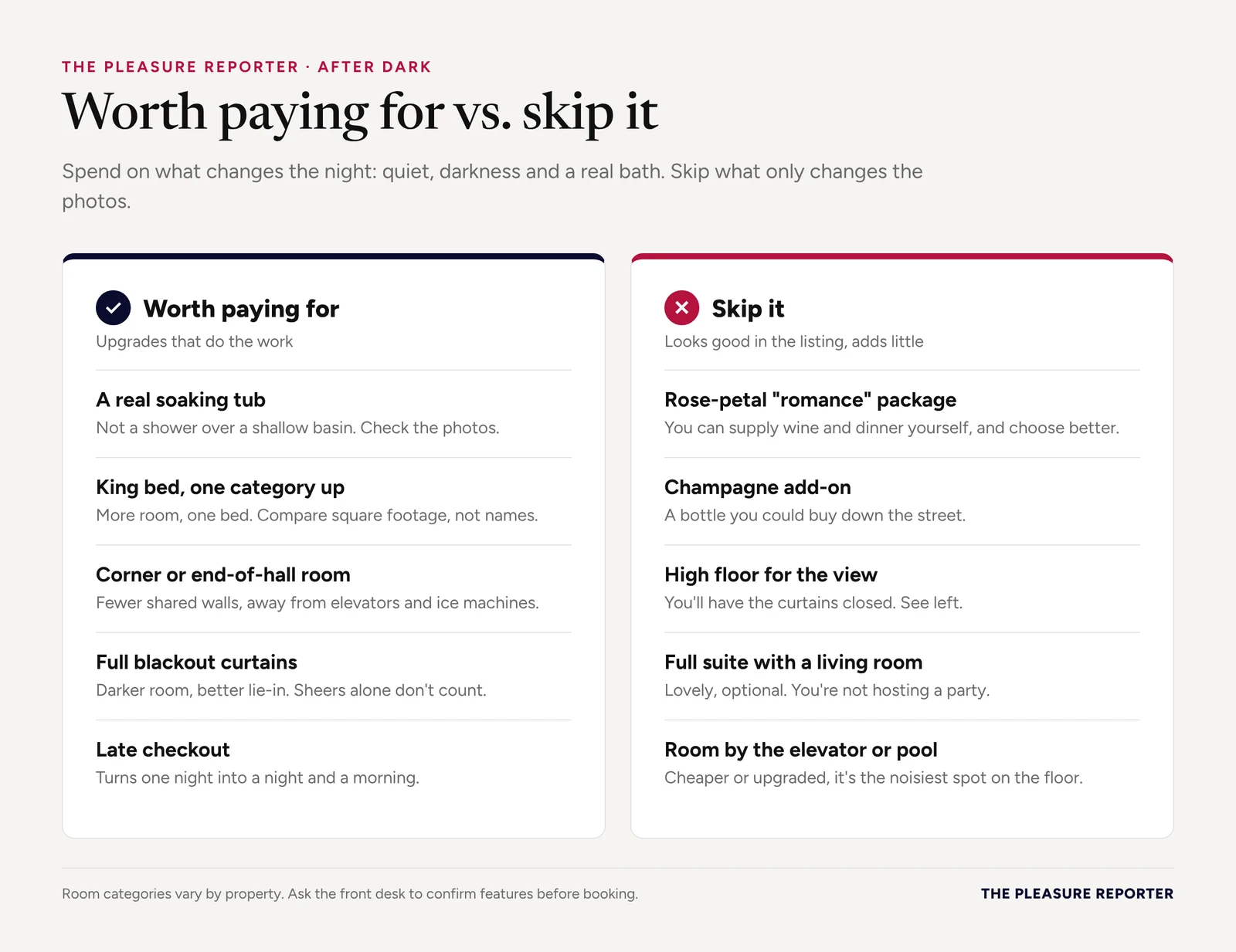
A step up from the entry-level room often buys you a king bed instead of two queens, a few more square feet and sometimes a separate seating area. That’s usually worth it. A full suite with a separate living room is lovely but optional; you’re not hosting a cocktail party. Category names are marketing; “deluxe” at one property is “standard” at another. Look for the actual square footage (or square meters) and the bed size.
Corner rooms
Corner rooms sometimes come with more space and windows on two sides, though that varies by building. The more reliable advantage is location: they tend to sit at the far end of the hallway, away from the elevators, the ice machine and guests coming and going. Fewer shared walls means fewer neighbors. The tradeoff is that the view can be the side of the building next door, which is fine. You’re not there for the view.
The bath
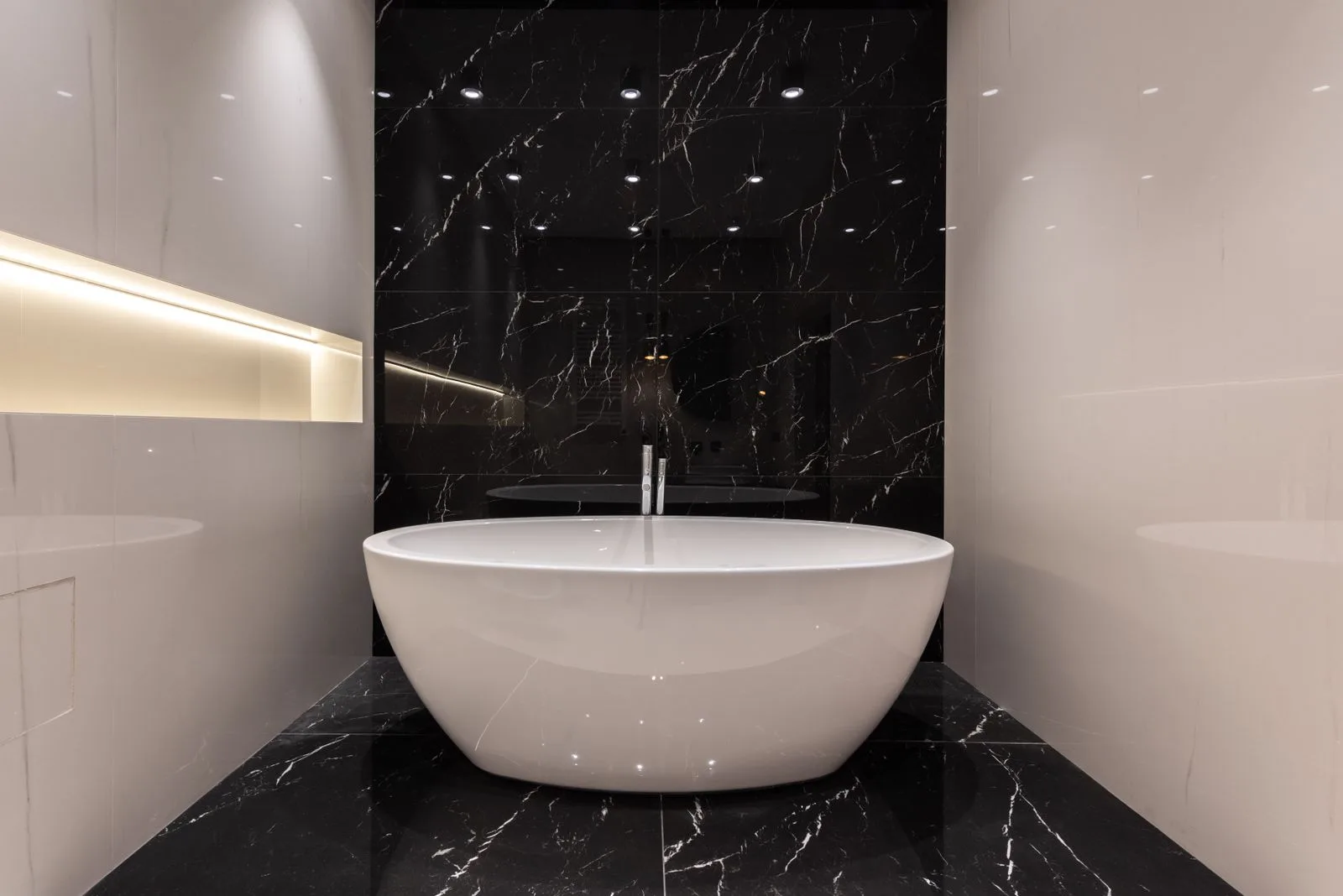
A real soaking tub, big enough for two or at least deep enough for one with company perched on the edge, is the single feature most worth paying extra for. A rainfall shower is nice. A tub is an evening. Check the room photos for the actual tub, since some listings say “bath” and mean a shower over a shallow basin.
Blackout curtains
This one is partly about mood and partly about sleep. In a small 2022 Northwestern study of 20 healthy adults, one night of sleeping with overhead room light raised nighttime heart rate and worsened next-morning insulin resistance compared with sleeping in dim light. One night won’t wreck your health, and the study was tiny. But a room that goes properly dark makes both the evening and the lie-in better, and a sliver of streetlight through a gap in the drapes is a surprisingly effective mood killer. Ask whether the room has full blackout curtains, not just sheers.
What to skip
The rose-petal package. The champagne add-on, which is usually a bottle you could buy for less down the street. A high floor purely for the view. And anything branded “romance” that costs more than a bottle of wine and a good dinner, because you can supply both yourself and choose better.
Questions to ask before you pay
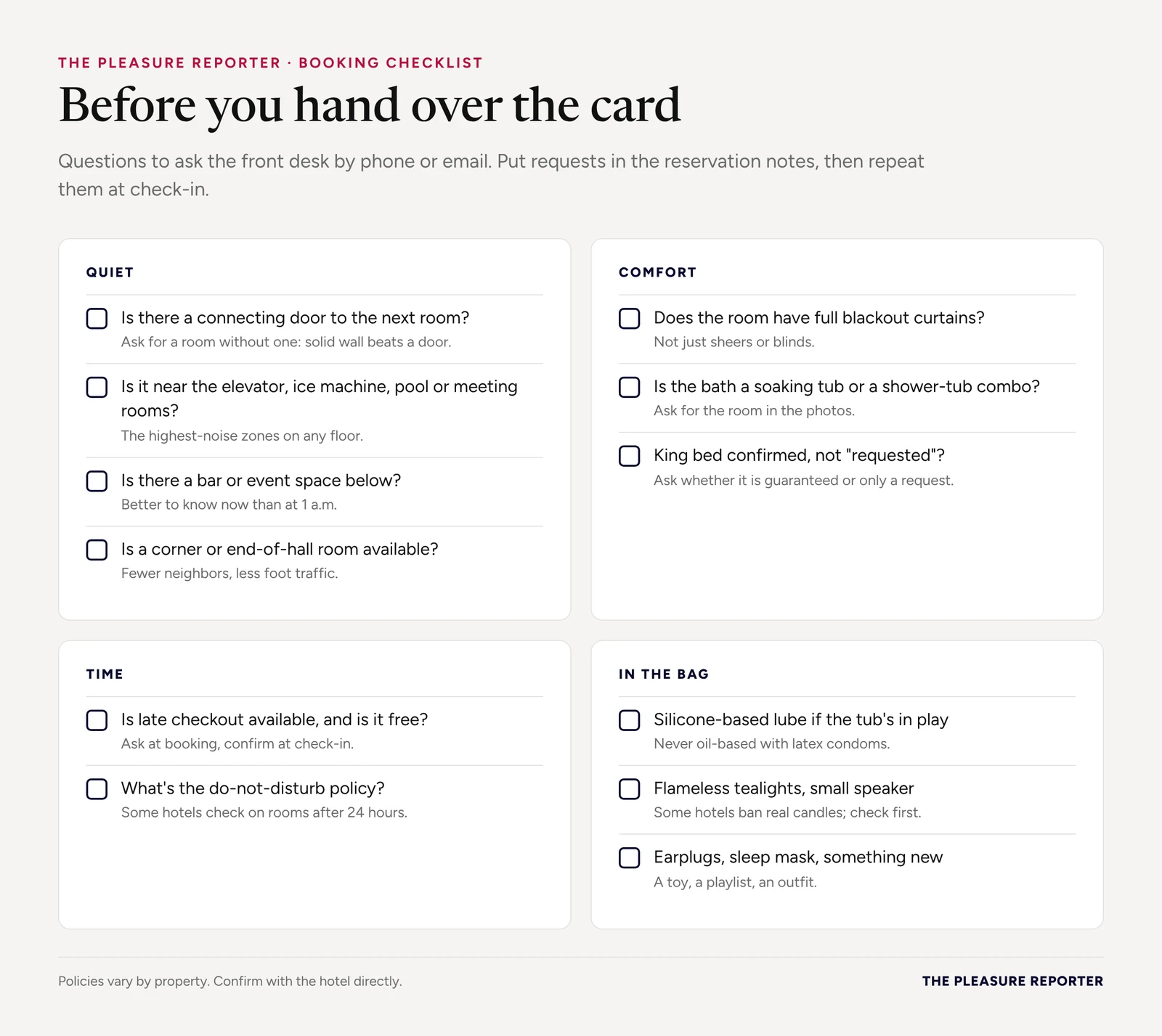
Booking engines are terrible at telling you the things that matter. A short call or email to the front desk fixes that. Hotel staff field these questions constantly; they won’t blush, and you shouldn’t either.
Soundproofing
Hotel walls are built to a sound rating called STC (Sound Transmission Class). Building code in the US calls for a minimum of 50 for walls and floors between units, many brands specify more, and every 10-point increase roughly halves how loud the noise next door seems. You won’t get a number from the desk, so ask questions that reveal the same thing:
- Is there a connecting door to the next room? A connecting door means a door in the shared wall instead of solid wall, and a door is harder to seal against sound. Ask for a room without one.
- Is the room near the elevator, ice machine, pool or meeting rooms? Those are the high-noise zones. Ask to be away from all of them.
- Is the heating and cooling unit under the window? Those in-room units cycle on and off, and a sudden burst of noise is more disruptive than a steady hum. Pack earplugs or a white-noise app if the answer is yes.
- Is there a bar, club or event space below? Better to know at booking than at 1 a.m.
Sound travels both ways, which is the polite reason to ask. If you want the full treatment on acoustics, read our guide to building a room that sounds right; most of the principles about hard surfaces and soft furnishings apply in a hotel too.
Late checkout
Ask when you book and confirm at check-in. Late checkout turns a night into a night and a morning, and the morning is often the better half. Some properties offer it free when they can, some charge for it. The desk can tell you which.
The do-not-disturb policy
The sign still works, but it no longer means “never.” Since 2018, some major hotel companies and resort operators have adopted rules that staff will check on a room if the sign stays up for more than 24 hours. For a one-night stay that changes nothing. For a long weekend in, it’s worth knowing that a quick knock or a call is a welfare check, not housekeeping being nosy. Ask at the desk what their policy is, and if you’d rather skip daily cleaning altogether, say so.
What to pack
The hotel covers towels, shampoo and the bed. You cover the parts that make it yours.
- Lube, and the right type. If the tub is part of the plan, water-based lube rinses away fast. Silicone-based lasts longer and is safe with all condom types. Oil-based lube breaks down latex, so keep it away from latex condoms. Our guide to lubes goes deeper.
- Condoms, if you use them. Gift shops don’t always stock them and the pharmacy might be closed.
- Something new. The research is about novelty, so bring some. A toy you haven’t used together, a playlist neither of you has heard, an outfit the other person hasn’t seen. If a toy is on the list, our discreet kit guide covers travel locks, cases and getting through airport security without a conversation.
- Battery tealights. Open flames and hotel smoke detectors are a bad mix, and some properties ban candles outright. Flameless ones give you the light without the fire alarm.
- A small speaker, kept at a volume your neighbors won’t learn the lyrics to.
- Earplugs and a sleep mask, in case the room loses the soundproofing lottery or the curtains have a gap.
- A plan for the morning. Breakfast in bed, a walk, a long shower. Our piece on the morning after has ideas.
Leave the laptop at home. If you must bring a phone charger, put it on the far side of the room. A hotel nightstand with your phone glowing on it is just your bedroom with worse Wi-Fi.
The small-budget version
You don’t need a flight, a resort or a suite. The research never involved any of those. What it involved was doing something new together, and a room in your own city, booked for one night, delivers almost all of the cue-swapping benefit for a fraction of the cost of a trip.
A few ways to make the money go further:
- Stay local. A staycation cuts out travel time, gas and flights, so the money that would have gone to getting there can go to a better room. Pick a neighborhood you rarely visit so the walk to dinner is new too.
- Check several dates. Rates move with demand, so compare a few nights before you commit.
- Book the standard king and spend on the extras that count. If the budget stretches to one upgrade, choose late checkout or the room with the tub over a bigger room with a better view.
- Bring dinner up. Takeout from a place you love, eaten in a robe on a bed someone else will remake, beats a restaurant reservation more often than you’d expect.
- Arrange the childcare. If kids are part of your life, the night is only as good as the plan for them. Sort it early so neither of you spends the evening checking a phone.
One night is enough. The Aron experiments got measurable results from seven minutes. You have about 18 hours between check-in and late checkout. That’s a lot of Velcro.
Once you’re through the door
The room does a lot of the work, but not all of it. A few habits help you get the benefit you paid for.
Do something new outside the room, too. The Muise studies tied desire to shared activities that felt new or challenging, not just to being somewhere unfamiliar. Walk a neighborhood neither of you knows, or try a cuisine you’ve never ordered. The hotel is the base; the novelty can be anywhere in a few blocks’ radius.
Don’t script the evening. Turning the night into a performance with a schedule tends to undo the point. Let it be slow. If that idea appeals, our piece on taking twice as long is good reading for the drive over.
Put the phones away. The household cues you checked out of will come right back through a notification. Do-not-disturb mode on the phone matters as much as the sign on the door.
Talk about the next one. The Coulter and Malouff trial asked couples for a regular weekly dose of shared excitement, not a single grand gesture. A hotel night is a good reset, not a cure. The couples in that study kept some of the benefit four months later, and they had been doing something new together every week. Book the room, and then put the next new thing on the calendar.
Quick answers
Is it awkward to ask the front desk about soundproofing?
No. Light sleepers, shift workers and parents with babies ask the same questions every day. “Can I have a room away from the elevator and without a connecting door?” is a completely normal request. Put it in the reservation notes, then repeat it at check-in, since room assignments are often finalized on the day.
Does a hotel night help if our sex life has stalled for a long time?
It can help as one part of a plan, but the research doesn’t show a single night fixing a long-running problem. If low desire is persistent or causing distress for either of you, talk to a doctor, since medications, hormones, sleep and mood can all play a part, or see a certified sex therapist or couples counselor.
Is an apartment rental just as good?
For novelty, often yes: it’s still a new place without your household cues. The tradeoffs are that rentals rarely have a front desk to ask about noise, walls in converted homes can be thin, and cleaning-fee checklists put chores back in your morning. A hotel takes the chores off your hands entirely.
Can we use the hot tub or pool for anything beyond swimming?
Not in shared facilities. They’re public spaces, and hotels and laws treat them that way. Keep it to your own room. In a private in-room tub, remember that water rinses away water-based lube quickly, so silicone-based is the better bet.
Should we tell the hotel it’s a special occasion?
Yes, if it’s true. Mentioning an anniversary or birthday at booking costs nothing, and some properties respond with a better room assignment or a small note in the room. Don’t count on an upgrade, and don’t invent an occasion.