Build a Room That Sounds Like Sex
Speakers, records and the late-night playlists that don't sound like a spa.
Most bedrooms sound like an afterthought. There is a phone face-up on the nightstand playing something through a speaker the size of a matchbook, a bare window throwing every note back into the room, and a ceiling fan supplying the rhythm section. Then someone reaches for the phone halfway through to skip a track that sounds like a hotel lobby, and the moment goes to sit in the corner.
You don’t need a studio to fix this. You need a room that soaks up a little of what it hears, a pair of speakers put somewhere sensible, a volume that keeps the neighbors out of your business, and a playlist built on purpose rather than pulled from a search bar at 11:40 p.m. None of it is expensive in effort, and most of it is just moving furniture you already own.
What follows is the physics, the hardware, and the research on tempo, with the evidence graded honestly. Some of it is solid acoustics. Some of it is one lab study and a lot of marketing. We’ll tell you which is which.
The short version: Soften the room (rug, heavy curtains, upholstered headboard), put two speakers in a rough triangle with the bed and off the shared wall, keep bass modest because it is what leaks through walls, use steady background noise to cover what you can’t muffle, and build a playlist that changes tempo on purpose instead of droning at one speed.
Your bedroom has an echo problem
Sound in a room does two things: it goes straight to your ears, and it bounces off every hard surface before arriving a few milliseconds later. Too much of the second and music turns smeary while every other noise in the room gets amplified with it. Acoustic engineers call the fix absorption, and the cheapest absorbers are things you would put in a bedroom anyway.
Soft, porous materials work best on mid and high frequencies, which is where voices, cymbals and the slap of a bare room live. They do very little for deep bass. Sound On Sound, testing porous absorbers, found that at 100 Hz none of the products it measured absorbed much, and that absorbing a 52 Hz note with that kind of material would take a layer around 65 cm (about 25 inches) thick. Nobody’s duvet is that committed.
Here is where your money and effort should go, in order:
- A rug. Hardwood and laminate are mirrors for sound. Carpet’s absorption varies enormously by product: the same Sound On Sound piece lists coefficients at 1,000 Hz from roughly 0.1 to 0.8, so a thick pile rug with an underlay does far more than a flat-weave runner.
- Heavy curtains, hung full. Thin drapes from the home section barely register. The folds are what absorb, and deeper folds hold the fabric off the wall and work harder. Glass is one of the worst surfaces in any room, and a bedroom window is usually a large one.
- The bed itself. A duvet performs roughly like flat foam of the same thickness, according to the same testing. An upholstered headboard, a stack of pillows and a throw on a chair all count.
A bedroom is already the softest room in most homes. Treat the hard surfaces nearest the bed first.
Where the speakers go
Placement advice holds up because it is geometry rather than taste. KEF’s placement guide suggests spacing a stereo pair so that the speakers and the listening position form an equilateral triangle, with each speaker 300 to 1,000 mm (roughly 1 to 3 feet) from the wall behind it, both at the same distance. Cambridge Audio adds that tweeters should sit roughly at ear height, since high frequencies are directional, and that a slight inward angle of 10 to 15 degrees usually works.
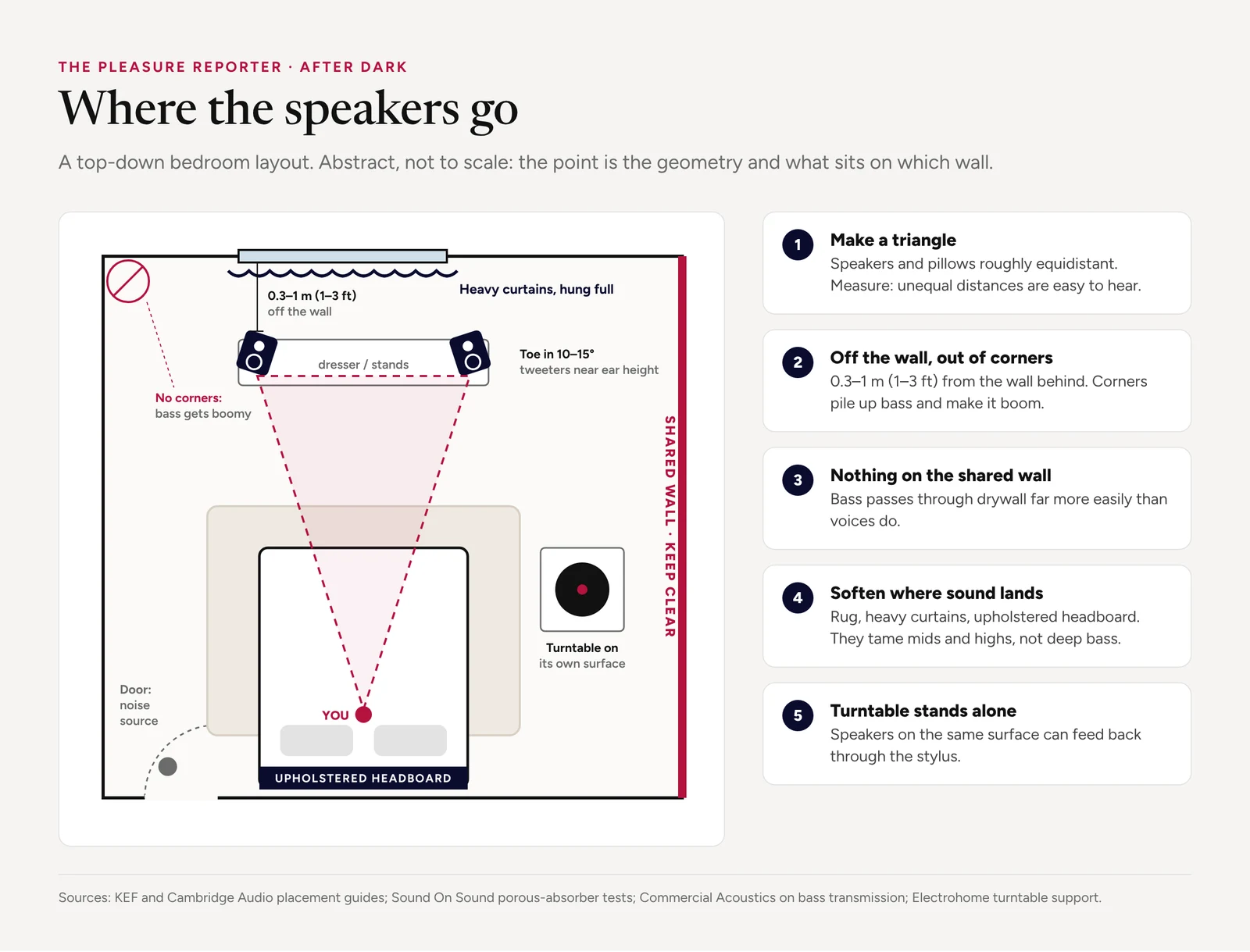
A bed complicates the triangle, because you are not sitting upright in a chair. Aim the triangle at the pillows, and if your speakers are small, put them on stands or a dresser across from the bed rather than flat on nightstands where the tweeters fire at your ankles. Nightstands are fine for very small speakers at low volume.
Three rules matter more than the rest:
- Stay out of the corners. Bass builds up near boundaries, and a speaker pushed into a corner sounds boomy, as Cambridge Audio puts it. Boomy is also leaky, for reasons the next section covers.
- Keep the shared wall clear. If you live in an apartment, condo or duplex, put the speakers on a wall that backs onto your own space, a closet or the outside, never against the wall your neighbor sleeps behind.
- Measure. KEF notes that differences in the distance from each speaker to your ears are easy to hear. A tape measure takes thirty seconds.
Pick the box: bookshelf pair, smart speaker or turntable

There are three sensible setups for a bedroom, and they suit different people. Prices move constantly, so we’ll stick to what each type does.
A pair of bookshelf speakers
Two small speakers, either powered (with an amplifier built in) or passive (with a separate amplifier), give you real stereo: instruments placed left and right, a voice sitting in the middle. Cambridge Audio’s guide notes that bookshelf models suit closer spacing and near-field listening, which is exactly what a bedroom is. Powered pairs with Bluetooth or Wi-Fi are the least fuss. This is the setup that makes a room sound expensive.
One smart speaker, or two
A single smart speaker is mono. It fills a room with sound but not with space, and it often sits in the worst possible spot: a corner, on a shelf, pushed against the wall. The fix is a second one. Sonos and Google both support stereo pairing, and both require the two units to be the same model. Sonos’s own support page suggests spacing a pair around 8 to 10 feet apart, and notes that closer spacing increases bass. The upside is convenience: voice control means nobody reaches for a phone with the light on it.
A turntable setup
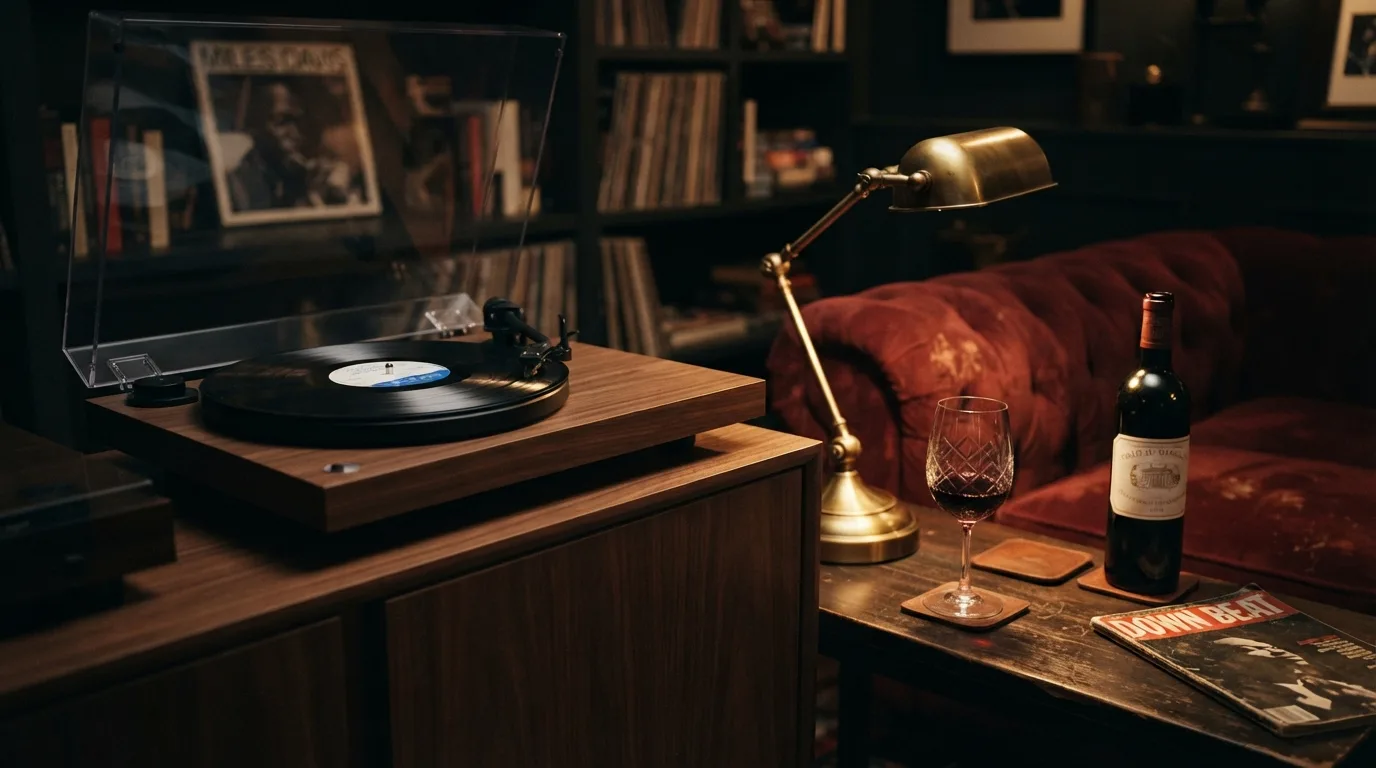
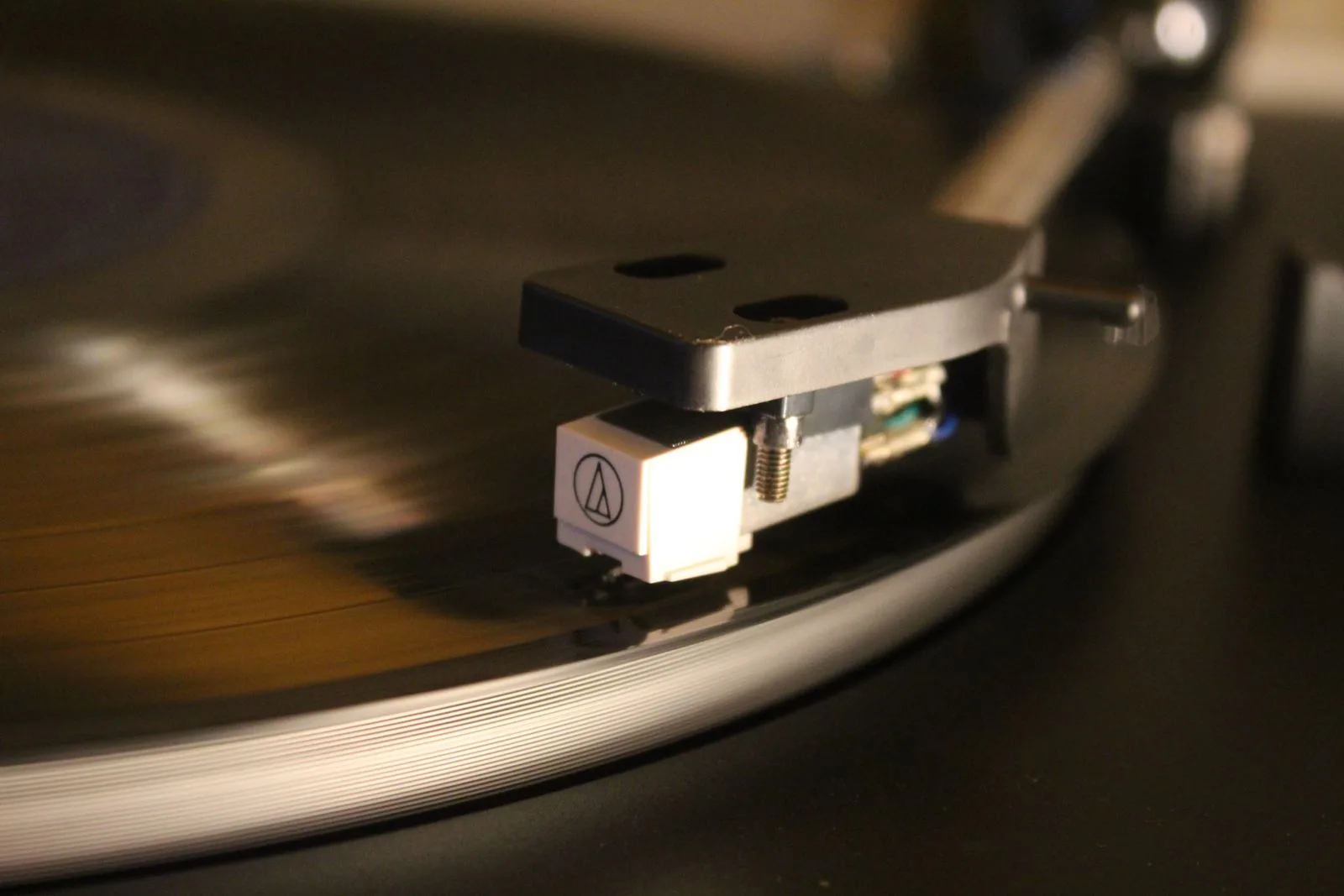
Records have one quality no streaming service has: a side ends, and someone has to get up and flip it. Whether that is a feature depends on you. The practical catch is vibration. A turntable reads grooves by vibration, so if the speakers share its surface, the stylus picks up their output too and can feed back on itself. Electrohome’s support guidance is blunt: the speakers should not be on the same surface as the turntable, which should sit on something flat, level and solid.
| Setup | Best at | Weak spot | Bedroom tip |
|---|---|---|---|
| Bookshelf pair | Real stereo, detail at low volume | Cables, space, placement effort | Stands or a dresser across from the bed |
| Single smart speaker | Hands-free control, small footprint | Mono, often corner-placed | Pull it out of the corner, off the shared wall |
| Stereo-paired smart speakers | Convenience plus stereo | Both must be the same model | One on each side of the room, not side by side |
| Turntable rig | Ritual, whole-album listening | Feedback, someone has to flip the record | Separate solid surface from the speakers |
Volume is a privacy setting
The person you most want to keep out of this playlist is the one on the other side of the wall. Here the physics is in your favor in one way and against you in another.
The against: bass travels. Low notes have long wavelengths (around 3.4 m, or 11 feet, at 100 Hz) and ordinary walls are poor at stopping them. An acoustics firm’s breakdown of the mass law gives a single layer of drywall on studs roughly 40 dB of reduction at 1,000 Hz but only about 22 dB at 100 Hz. That is why your neighbor hears the kick drum and never the singer. Turning down the bass, or the subwoofer if you own one, cuts leakage more than turning down everything.
Your neighbor hears the kick drum and never the singer.
The in your favor: steady sound hides unsteady sound. Offices use this deliberately. Commercial sound masking adds a low, constant background tuned to speech frequencies, which makes nearby voices harder to understand without canceling them. Cambridge Sound Management describes it as shrinking the radius at which speech is intelligible, and it states that masking does not eliminate speech. Office systems typically run around 42 to 48 dBA, a little above the hum of a refrigerator.
At home, the same trick is a fan, a noise machine or a steady track of white, pink or brown noise. Pink and brown noise lean toward lower frequencies (brown more steeply), which is why they sound like rain or a distant waterfall rather than radio static. Be clear about what the evidence supports, though. A 2021 systematic review in Sleep Medicine Reviews looked at 38 studies of continuous noise as a sleep aid and rated the quality of evidence very low, and Cleveland Clinic notes that research on brown noise specifically is minimal. Masking for privacy is better established than masking for sleep, because it is just acoustics: a constant sound raises the floor that other sounds have to clear. Place the noise source near the door or the shared wall, keep it modest, and don’t run it at high volume all night. Prolonged exposure above 70 dB can harm hearing, according to Nationwide Children’s Hospital’s reference chart.
The toy in the room
Music also covers motors, and toys are not silent. For scale: a whisper is around 38 dB, a refrigerator hum around 40 dB, and people talking around 60 dB. In our Lovense Gush 2 review we measured it at 55 dB and found it one of the quieter vibrating toys we’ve used. The Domi 2 is a different animal: we estimated around 60 dB at full power, which carries through a thin wall or a closed door. Its lower settings, where most people spend their time, are far less of a problem. If walls are thin, a quieter toy plus a modest playlist plus a noise source near the door is a better plan than turning the music up to cover a wand. If you’re adding one to the evening for the first time, our guide to bringing a toy into bed covers the conversation part.
What tempo actually does
The most quoted study here is solid and narrow. In 2005, Luciano Bernardi and colleagues published a study in the journal Heart that played six styles of music to 24 healthy adults (12 trained musicians, 12 not) at tempos from 55 to 150 beats per minute. Faster music raised breathing rate, heart rate and blood pressure. Slower music had smaller effects, and a slow raga at 55 BPM produced the largest drop in heart rate. The responses tracked tempo, not genre: fast classical and techno did roughly the same thing to the body, and so did the three slow pieces. Whether people liked the music made no difference to the results.
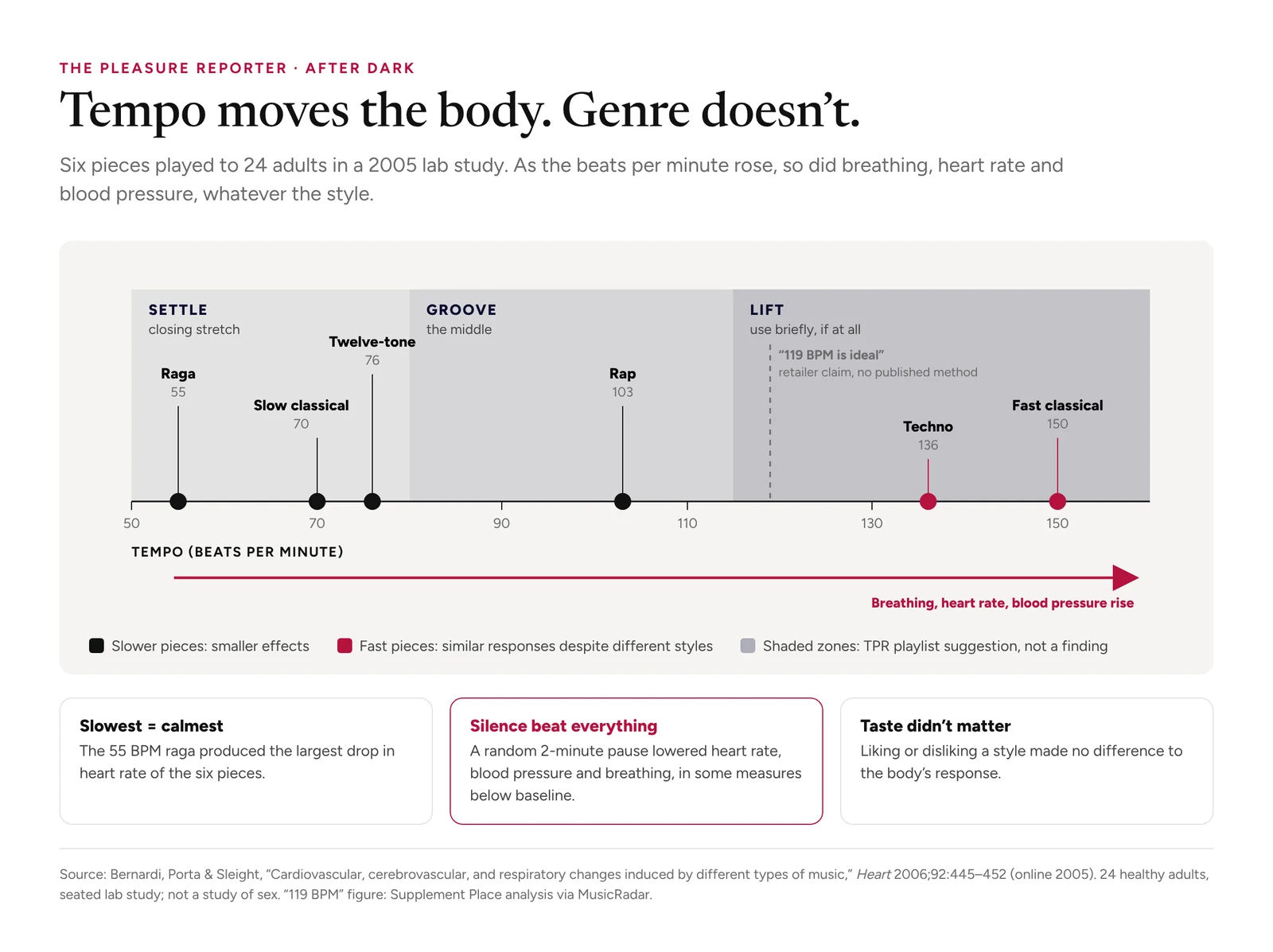
The finding that gets less attention is the most useful one. When the researchers dropped in a random two-minute silence, heart rate, blood pressure and breathing fell, in some measures below the starting baseline. The contrast did the relaxing.
A second line of research separates arousal from mood. Husain, Thompson and Schellenberg, writing in Music Perception in 2002, played the same Mozart sonata at different speeds and in major and minor keys. Tempo changed how aroused listeners felt. Key changed their mood. Fast and sad is possible; so is slow and warm. A good late-night playlist lives in that second category.
Now the caveats. These were lab studies, with people sitting still and wearing sensors, and neither looked at sex. “Arousal” here means physiological activation, the same thing a brisk walk produces. The figure you’ll see repeated online, that 119 BPM is the ideal tempo for sex, comes from an analysis by a supplement retailer, reported without a method or peer review. A 2024 survey by an online prescription service found 47% of respondents said they regularly play music during sex, which tells you it’s common, not what works. Treat any precise “perfect BPM” as marketing.
What the research does support is simple: tempo moves the body, faster pushes it up, slower lets it settle, and changes in tempo register more than any single speed. Build for the change.
The spa music trap
The spa playlist is what happens when you search “sensual” and accept the first result. Soft synth pads, a flute, maybe some water. It’s designed for a stranger to fall asleep face-down on a massage table. It does that job well.
It fails in a bedroom for three reasons. It sits at one slow, unchanging energy level, and the Bernardi data suggests the body responds to change. It has no pulse, so there’s nothing to move with. And it carries associations: the moment your brain files it under “waiting room,” it has stopped being background and started being a joke.
Spa music is designed for a stranger to fall asleep face-down on a massage table. It does that job well.
The opposite trap is the playlist you run to. Anything you’ve heard at the gym or in a car with your family comes with luggage.
Build the playlist by era and genre
Think in three stretches rather than one long list: a warm-up for when you’re still talking, a middle with a heavier groove, and a slower closing stretch. Two to three hours total means nobody needs to touch a screen. Turn off autoplay so a stranger’s algorithm doesn’t pick the next song, and if your service inserts ads, the free tier is not for tonight.
Warm-up: seventies soul and slow funk
This is the era that wrote the template. Marvin Gaye’s 1976 album I Want You is close to a single continuous mood. Al Green’s early-seventies records, Isaac Hayes’s Hot Buttered Soul, and Minnie Riperton bring warmth without hurry. The recordings are live-sounding and roomy, which flatters small speakers.
The middle: nineties trip-hop and neo-soul
Slow tempos with heavy, physical beats are the sweet spot for the middle stretch. Massive Attack’s Mezzanine and Portishead’s Dummy are dark and unhurried. D’Angelo’s Voodoo and Erykah Badu’s Baduizm have grooves that sit slightly behind the beat. Sade’s Love Deluxe belongs anywhere in this list. Keep the bass knob in mind here: this is the material your neighbor will hear first.
Closing: modern minimal R&B and downtempo
Later in the evening, strip it back. The xx’s debut album, Rhye’s Woman, Frank Ocean’s Blonde and Khruangbin’s instrumental-heavy records are spare and close-miked. Air’s Moon Safari works if you want something lighter. Instrumentals help as the night goes on, because lyrics pull attention.
Rules for the whole list
- Vary the tempo on purpose. Drift up through the middle, come down at the end. A single speed for two hours is just the spa playlist with drums.
- Leave a gap. A deliberate silence between stretches is not a mistake. In the Heart study, the pause was the most relaxing part.
- Play it through once beforehand, at the volume you’ll use, on the speakers you’ll use. Shuffle surprises are rarely good ones.
If you’re planning a long evening, this pairs well with taking twice as long, and if you’re setting up a room that isn’t yours, the hotel-room guide covers what travels.
Quick answers
Do I need a subwoofer in a bedroom?
Usually not. A bedroom is small enough that decent bookshelf speakers produce plenty of low end, and bass is the part of the music that leaks through walls and floors most easily. If you do own one, keep it at least 30 cm (about 12 inches) from a corner, as Cambridge Audio advises, and turn it down before you turn anything else down.
Is Bluetooth good enough, or do I need Wi-Fi speakers?
For background listening at bedroom volume, Bluetooth is fine. The bigger risk is the phone itself: whatever it is streaming from, a call or a notification chime can cut into the music, and the screen lights up the room when you reach for it. Turn on do-not-disturb before you start, and if your speakers support voice control or a remote, use that instead.
Will acoustic foam panels soundproof my room?
No. Foam and other porous absorbers reduce echo inside a room; they do almost nothing to stop sound passing through a wall, especially bass. Soundproofing means mass, sealed gaps and decoupled construction, which is renovation work. For a rental, a rug, heavy curtains, a door draft stopper and a masking noise near the shared wall are the realistic toolkit.
How loud is too loud for a noise machine?
There’s no official guideline for sleep, but the Sleep Foundation suggests keeping it around the level of a background conversation or light rustling, and placing the machine in a corner of the room. Prolonged exposure above 70 dB, roughly a vacuum cleaner, can harm hearing. If you find yourself raising your voice over it, it’s too loud.
Is there a best BPM for sex?
Not one that research has found. The lab evidence shows faster tempos raise heart rate and breathing and slower ones lower them, but those studies didn’t test sex, and the widely shared “ideal BPM” figures come from marketing analyses without published methods. Change the tempo across the evening rather than chasing a number.