Slow Is a Skill: The Case for Taking Twice as Long
Edging, pacing and why the best nights are the unhurried ones.

Most men treat sex like a commute. There’s a start, there’s a destination, and the goal is to get there without incident. The trouble is that the destination arrives in about the time it takes to boil an egg, and nobody has ever described a boiled egg as the highlight of their week.
Slow sex is the fix, and it is less mystical than it sounds. It isn’t tantra, it isn’t a retreat in Sedona, and it doesn’t require incense. It’s a set of plain, teachable skills: knowing where your arousal sits at any given moment, backing off before you run out of road, and spreading the good part across an evening instead of cramming it into a commercial break. Sex therapists have been teaching versions of this since the 1950s. Most of it can be practised alone, on a Tuesday, with the door locked.
What follows is what the research actually says about how long sex lasts, how long people want it to last, and the clinical techniques built to close that gap. Where the evidence is thin, we’ll say so.
The short version: In the best-known stopwatch study, the median time from penetration to ejaculation was 5.4 minutes. Couples in a Canadian survey said they’d like roughly twice the foreplay and intercourse they were getting. The stop-start and squeeze techniques, plus Masters and Johnson’s sensate focus, are the oldest tools for stretching that time. The evidence behind them is modest but real, and they cost nothing to try.
What the stopwatch actually says
The most quoted number in this field comes from a 2005 study led by Marcel Waldinger, published in the Journal of Sexual Medicine. Researchers recruited 500 couples across the Netherlands, the UK, Spain, Turkey and the US, handed them stopwatches and asked them to time every act of intercourse for four weeks. The clock started at penetration and stopped at ejaculation. The median result was 5.4 minutes.
The range is the more interesting part. Individual men’s medians ran from about half a minute to 44 minutes. Times fell with age, from a median of 6.5 minutes among men aged 18 to 30 down to 4.3 minutes in men over 51. Condoms made no measurable difference, and neither did circumcision in the countries where that was compared. So the two excuses most men reach for first don’t hold up.
A few caveats worth keeping in mind. The study measured penetrative, heterosexual intercourse only, so it says nothing about the rest of the evening. Couples knew they were being timed, which is not exactly a recipe for relaxed sex. And a median is a midpoint, not a target.
Then there’s the question of what counts as good. In 2008, researchers Corty and Guardiani surveyed members of the Society for Sex Therapy and Research (34 of 50 responded) and asked how long intercourse should last. Their answers: 1 to 2 minutes was too short, 3 to 7 was adequate, 7 to 13 was desirable, and 10 to 30 was too long. That last figure matters. Nobody who studies this for a living is telling you to go for an hour.
The gap shows up when you ask couples what they want. A 2004 study by Miller and Byers at the University of New Brunswick asked 152 heterosexual couples to estimate how long foreplay and intercourse actually lasted, and how long they’d like them to last. Women reported about 7 minutes of intercourse and said they’d prefer about 14. Men reported about 8 and wanted something in the high teens. Foreplay followed the same pattern: around 11 to 13 minutes actual, around 18 to 19 ideal, for both sexes.
Both partners, independently, wanted roughly twice what they were getting. That’s the headline.
Those are self-reported estimates, and people are bad at judging time when they’re enjoying themselves. But the direction is consistent and it’s the reason for the title of this piece. The ask isn’t marathon sex. It’s double, and a good chunk of that doubling is supposed to happen before anyone takes their pants off.

The arousal curve, and why sprinting flattens it
The cleanest way to picture this is a graph. Put arousal on the vertical axis and time on the horizontal. Near the top is a line that sexual medicine calls ejaculatory inevitability, the point of no return. Once you cross it, the reflex runs on its own. Physiologically, the first phase of ejaculation, called emission, is driven by the sympathetic nervous system: the same branch that handles stress and alarm. That’s a useful detail, because it means anxiety and urgency are working for the reflex, not against it.
A sprint is a straight diagonal line. Arousal climbs steadily from the first kiss to the finish, and the whole thing is over in the time it takes the line to reach the top. There’s nothing wrong with that occasionally. But it spends almost no time in the zone that feels best, which is the high plateau just below the line.
Edging changes the shape. You climb to roughly 7 or 8 out of 10, back off to a 4 or 5, climb again, back off again. Each wave spends more time near the top. The graph above is a model, not a measurement, but it captures the idea: you’re not adding more sensation, you’re spending longer where the sensation is good. You’re also learning to read the dial, which is the real point. Most men only know two settings on their own arousal: “fine” and “too late.”
Sensate focus: the slowest homework ever assigned
William Masters and Virginia Johnson developed sensate focus in the 1960s as a treatment for couples with sexual difficulties, and therapists still use it more than half a century later. The premise is almost comically simple. You touch each other, and you’re not allowed to try to get anywhere.
The structure varies a little by clinic, but a typical program runs in phases. In the first, you take turns touching each other everywhere except the breasts and genitals, and intercourse is off the table. In the second, genital touch is allowed, but intercourse is still banned. Only in the later phases does penetration come back, and even then it’s slow, with the receiving partner in control of depth and pace. One Canadian hospital handout suggests sessions of 20 to 60 minutes, two or three times a week, for at least six weeks.
The instruction that makes it work is easy to miss. You’re meant to touch for your own interest, not to arouse your partner. Sex therapists Linda Weiner and Constance Avery-Clark, who have written extensively on the Masters and Johnson model, single out this distinction as the one people most often get wrong. You pay attention to temperature, texture and pressure, the warmth of a lower back or the difference between skin on the forearm and skin on the inner thigh. The aim isn’t arousal or orgasm. The aim is attention.
That sounds soft until you realize what it’s targeting. Therapists call it spectatoring: watching yourself from the outside during sex, checking your erection, wondering how you’re doing. Spectatoring is anxiety in a lab coat, and it’s very good at hurrying things along. Sensate focus pulls your attention back into your hands and skin, which is exactly where you need it if you’re going to slow down.
On evidence: a 2019 review by Avery-Clark and colleagues concluded that sensate focus may help with sexual and relationship satisfaction in couples with sexual difficulties. “May help” is the honest phrasing. You don’t need a diagnosed problem to borrow the idea, though. Even one evening with a rule against intercourse changes how a night unfolds.

Stop-start and the squeeze: edging with a clinical pedigree
Edging has a reputation as an internet invention. It isn’t. In 1956 a physician named James Semans described the stop-start technique as a treatment for premature ejaculation, and Masters and Johnson later built their squeeze technique on top of it. Both are still described on major clinic sites today.
Stop-start. Cleveland Clinic’s version: stimulate the penis until you’re close to orgasm, then stop for about 30 seconds until the urge fades. Repeat three or four times before you let yourself finish. That’s it. The skill is in the word “close.” Stop at a 9 and you’ll learn nothing except how a missed train feels. Stop at a 7 and you have room to come down.
The squeeze. Same setup, but when you’re near the edge, you or your partner gently squeeze the head of the penis for about 30 seconds, until the urge passes and the erection softens slightly. Then resume. It’s more hands-on and slightly less romantic, which is why many people use stop-start during partnered sex and keep the squeeze for solo practice.
How well do they work? A 2015 systematic review in Sexual Medicine by Cooper and colleagues pooled 10 randomized trials covering 521 men. In two trials, a package of squeeze, stop-start and sensate focus produced gains of roughly 7 to 9 minutes in latency compared with men on a waiting list. Behavioral techniques generally did less well than medication. Adding them to medication did a little better than medication alone. The reviewers rated the quality of the trials as unclear and called the evidence limited.
Read that plainly: these are not miracle methods, the trials are small, and nobody is going to patent stop-start. But they’re free, they have no reported side effects, and they train a skill that’s useful whether or not you have a clinical problem. If you’re lasting under a minute most of the time and it’s bothering you or your partner, that’s worth a conversation with a doctor rather than a homework sheet. Cleveland Clinic notes premature ejaculation is the most common sexual dysfunction in men, and there are effective treatments.
A four-week stop-start practice plan
Learning to edge with a partner on night one is like learning to parallel park on a busy street with your in-laws in the back. Start solo. The graphic below lays out a simple progression built on the clinical stop-start method: the 30-second pause and the three or four repetitions come straight from Cleveland Clinic’s description. The weekly structure is our suggestion, not a validated protocol, so adjust the pace to suit you.
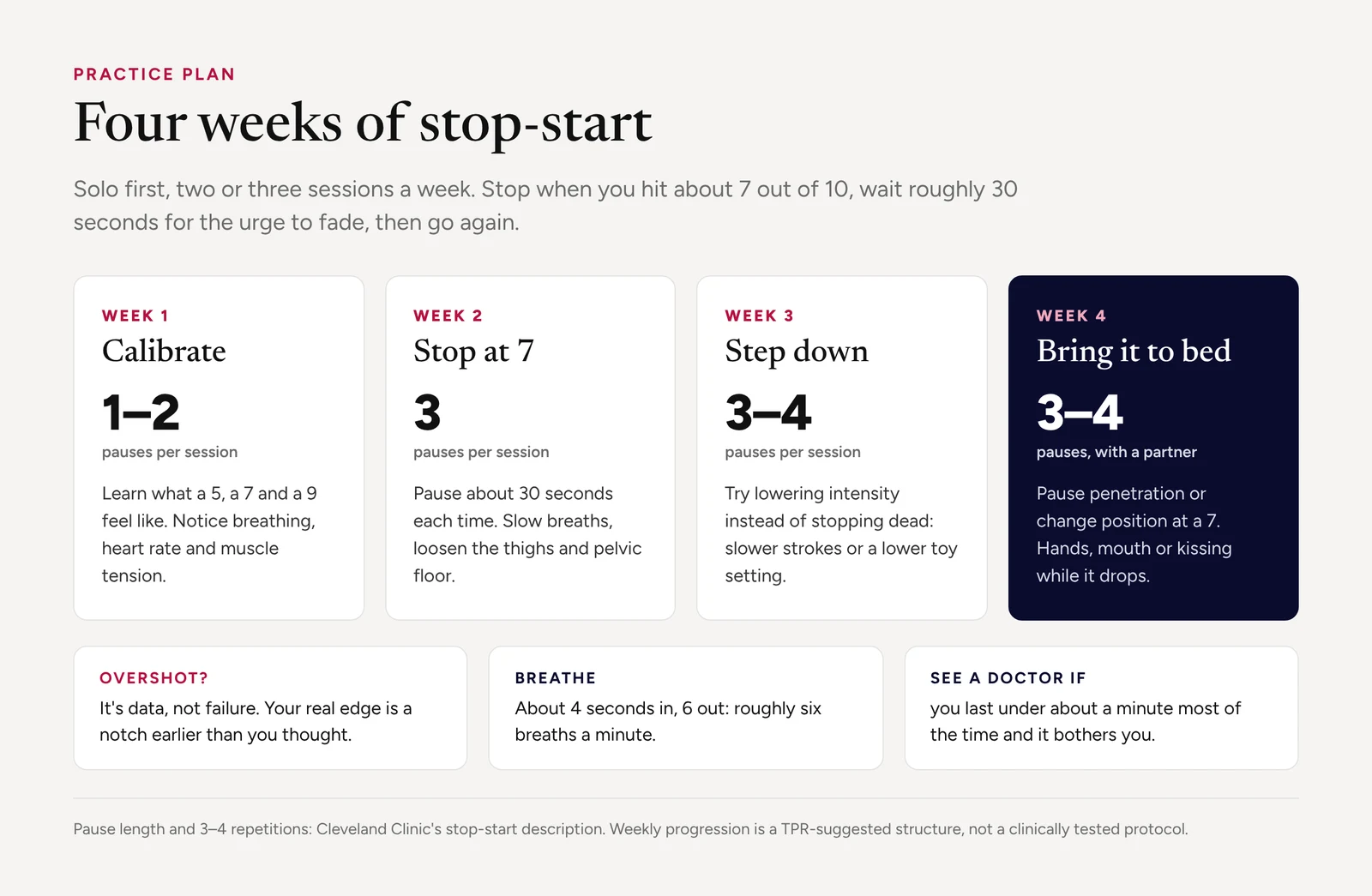
The first week is about calibration. Use a 1-to-10 scale in your head and notice what a 5, a 7 and a 9 actually feel like: breathing, heart rate, the tightness in your thighs and pelvic floor. Most men find that 9 arrives with less warning than expected. That’s the whole lesson of week one.
Weeks two and three are reps. Climb to a 7, stop, wait out the 30 seconds, climb again. Aim for three or four cycles before finishing. If you overshoot, don’t treat it as a failure. Treat it as data about where your real edge is. By week four, you can try the same thing during partnered sex, pausing penetration or switching to something that’s lower intensity for you, like kissing or focusing on your partner, while your number drops.
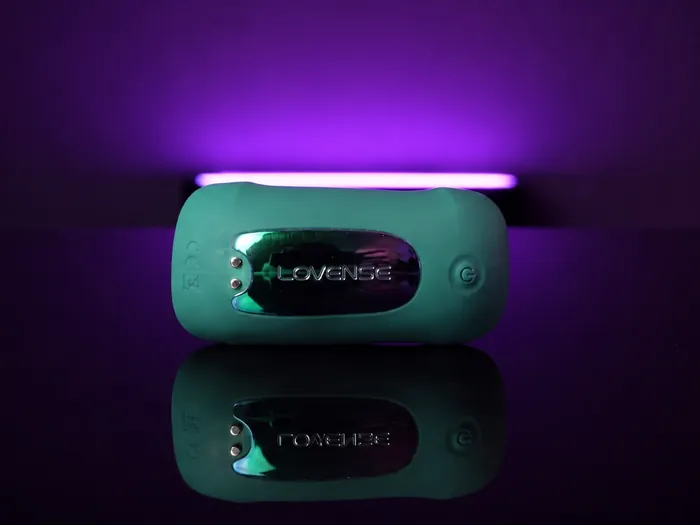
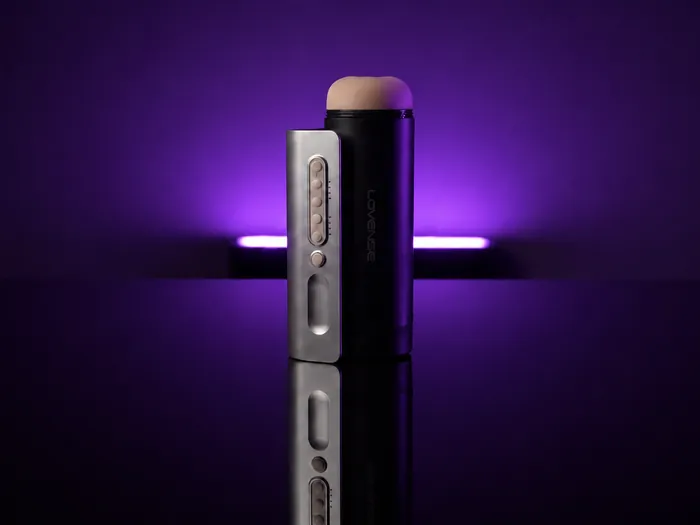
Toys with adjustable intensity are useful here because they let you change the input without changing much else. When we tested the Lovense Max 2, we found its lowest contraction setting worked as a gentle, rhythmic pressure suited to a long warm-up or an edging session. It has three vibration levels and three contraction levels, which gives you room to step down instead of stopping dead. The Lovense Solace Pro takes it further with speed up to 300 strokes a minute and stroke depth adjustable in fine steps, so you can drop to short, slow strokes when you’re near the line. The catch with any automatic toy is that it doesn’t feel you approaching the edge. You still have to hit pause yourself, which is, conveniently, the skill you’re training. Our best strokers guide covers the rest.
Pacing a whole evening
If the Miller and Byers numbers are right, a lot of the time people want isn’t intercourse at all. It’s everything before. So the most effective way to double the length of sex is to stop thinking of it as starting at penetration.
A useful frame is three acts. The first act happens before anyone is undressed: dinner, a drink, the walk home, the conversation that makes it clear where the night is going. It costs nothing to stretch, and anticipation is doing a lot of quiet work. Our piece on the hotel-room aphrodisiac covers how setting changes the tempo.
The second act is touch without a deadline. Borrow the sensate focus rule here: for the first stretch, intercourse isn’t on the menu. Undress slowly. Use your hands, your mouth, a toy if you both want one (we cover how to raise that in bringing a toy into bed). Take turns. Your partner’s arousal often builds on a different curve from yours, and this is where the two curves line up.
The third act is intercourse, and this is where stop-start earns its keep. Change positions when you hit a 7. Slow down instead of speeding up when it gets good, which goes against every instinct you have. Pull out and go back to hands or mouth for a minute. To your partner, these pauses just look like variety.

One honest note on scheduling: unhurried sex needs unhurried time. Starting at 11:40 p.m. with a 6 a.m. alarm is a recipe for a sprint no matter how good your intentions. Save the long version for nights when nobody has to be anywhere in the morning.
Breathing: the cheapest brake you own
Watch what your breath does as you approach orgasm. It gets fast, shallow and high in the chest, and you probably start holding it at the peak. That’s the sympathetic system taking over, the same one that drives emission. The obvious move is to push back on it.
The evidence for slow breathing is general rather than sexual. A 2018 systematic review by Zaccaro and colleagues looked at 15 studies of breathing slowed to under 10 breaths a minute. They found it generally increased heart rate variability, a marker linked to parasympathetic (rest-and-digest) activity, and that people reported feeling more relaxed and less aroused in the general, non-sexual sense. The studies were small and none were randomized trials. Nobody has run a trial measuring whether slow breathing adds minutes in bed, so treat this as reasonable physiology, not proof.
In practice it’s simple. When you pause at a 7, breathe in through your nose for about four seconds and out for about six. That works out to six breaths a minute, well inside the range studied. Consciously relax your pelvic floor, glutes and thighs, which tend to clench as you approach the edge. Two or three of those breaths during a 30-second pause usually brings your number down noticeably. For the longer-term side of this, including pelvic floor training, see our guide to stamina, sleep, breath and the pelvic floor.
Slow is a skill in the most literal sense. It’s learned through reps, it improves with attention, and like most skills, it feels awkward before it feels natural. The payoff is that you stop treating sex as something that happens to you at a fixed speed, and start treating it as something you can actually steer.
Quick answers
Is edging bad for you?
The randomized trials of stop-start and squeeze in the 2015 Cooper review reported no adverse effects, though the reviewers noted that safety reporting was sparse. That’s reassuring rather than conclusive. Practise at a pace that feels comfortable, and if anything hurts, stop and see a doctor.
How long should I practise before trying it with a partner?
Sensate focus programs typically run for at least six weeks, but stop-start is simpler. A few weeks of solo sessions, two or three times a week, is a reasonable starting point. You’re ready when you can reliably stop at a 7 and come back down, not when you’ve hit a particular number of minutes.
Does masturbating before sex help me last longer?
Some men find that ejaculating a while before sex helps, but the evidence for it is limited, and it isn’t on the standard clinical lists. Stop-start is the better-documented option, and unlike the pre-game approach, it also teaches you something you can use on any night.
What counts as premature ejaculation?
Many clinicians define it as ejaculating within about one minute of penetration, most of the time, for at least six months, and causing distress. The 2020 AUA and SMSNA guideline uses a threshold of about two minutes. If that sounds like you, a urologist or sexual medicine doctor can help; options include behavioral therapy, counseling and medication.
Do numbing sprays or condoms make a difference?
The evidence is mixed on condoms. In the Waldinger stopwatch study, condom use made no measurable difference to median latency, although Cleveland Clinic notes condoms can help some men by reducing sensitivity. Numbing creams and sprays are a recognized first-line option for premature ejaculation. They take roughly 10 to 30 minutes to absorb, and Cleveland Clinic advises washing before sex so they don’t numb your partner too. Talk to a doctor or pharmacist before using them.