The Morning After, Done Right
Coffee, conversation and why the next eight hours matter more than the last eight.

The night went well. That part is over, and you had very little to do with the logistics of it beyond showing up and paying attention. The morning is different. The morning is a hosting job, performed in daylight, on four or five hours of sleep, by a man who may or may not own a second clean mug.
It matters more than it looks. The research on what happens after sex is surprisingly consistent: the hours that follow shape how both of you remember the night and how you feel about each other days later. People forget the choreography of 1 a.m. They remember whether there was coffee, whether they were handed a towel or left to forage, and whether the text came the next morning or two days later.
So this is a guide to the next eight hours. What to have in the kitchen, how to make coffee that tastes like you meant it, a breakfast you can cook half-awake, the practical bathroom business, the conversation, the follow-up text, and how all of it changes when the person in your bed is someone you have woken up next to a thousand times.
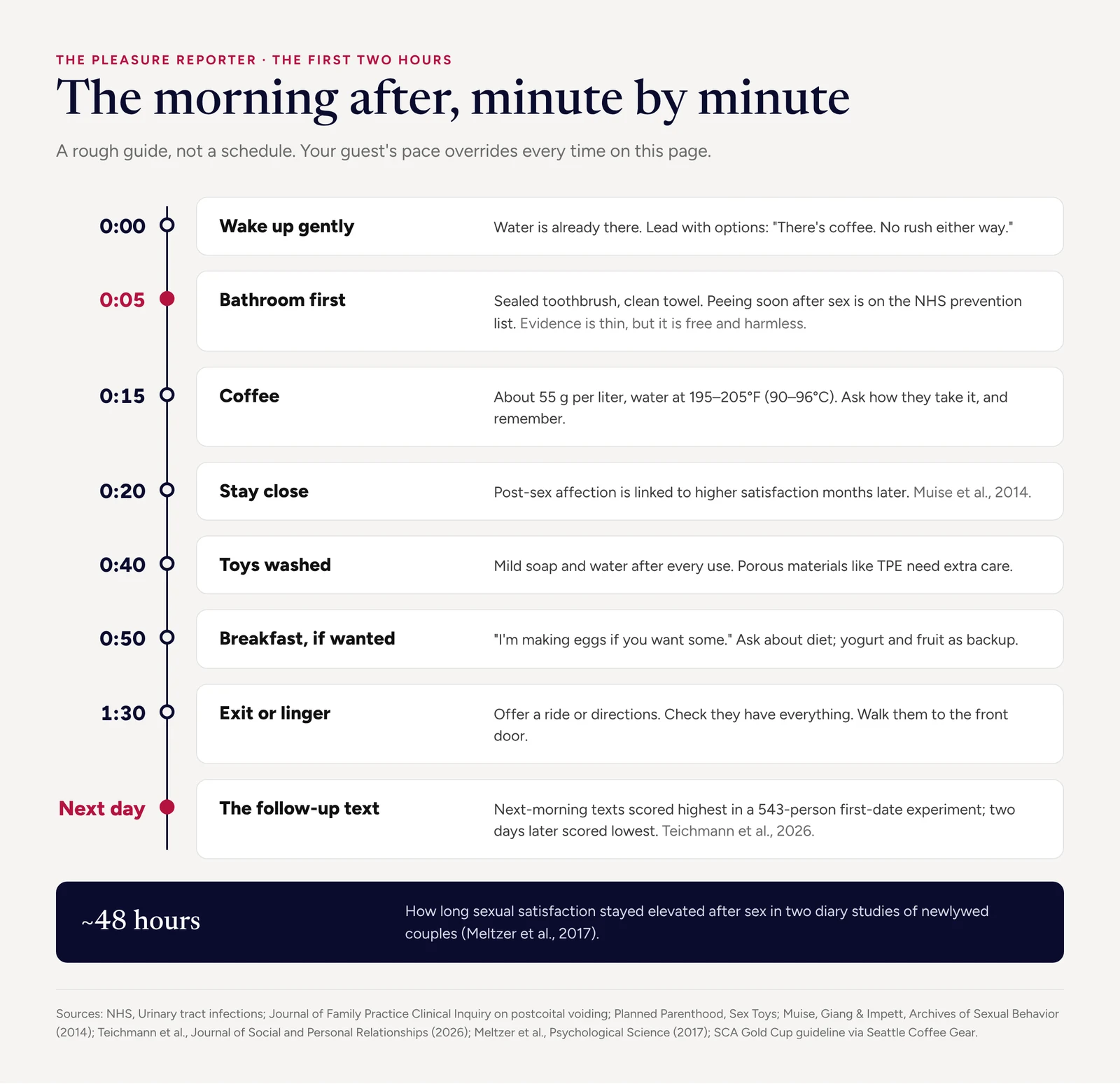
The short version: Stock a spare toothbrush, a clean towel and real coffee the night before. Let your guest set the pace in the morning. Peeing after sex is cheap, harmless and recommended by the NHS, though the hard evidence behind it is thin. Wash any toys before breakfast. If it was a first night, text the next day, not two days later. If it was a long-term partner, stay in bed ten minutes longer than you planned.
The setup happens the night before
The best morning-after hosts do almost all their work before anyone arrives. This is not about presuming anything. It is the same logic as owning a corkscrew: you buy it once and it quietly makes you look competent for years.
Start in the bathroom, because that is where your guest goes first and where your shortcomings are most visible. A sealed spare toothbrush is the single highest-return item in this article. The American Dental Association is blunt that toothbrushes should not be shared, and nobody wants to be offered yours anyway. Buy a multipack, keep one in the drawer, and hand it over still in the plastic. The unopened packaging does more talking than you need to.
Next to it: one clean bath towel that is clearly meant for a guest, folded and visible, not a damp one off the hook that has been doing duty since Tuesday. Add a hand towel, a hair tie if you have them, a basic face wash, and a bottle of moisturizer that is not exclusively aftershave balm. Clear the counter of anything you would rather not explain.
Then the bedroom. A glass of water on each side of the bed before lights out is a small kindness that pays off at 3 a.m. and again at 7. Know where a phone charger is. Know where the spare blanket is, since not everyone sleeps at the temperature you do. And if the evening involved toys, have a spot to set them aside until you can deal with them properly, which we will get to.
The kitchen needs less than you think. Good coffee, milk plus one non-dairy option, tea for the person who does not drink coffee, eggs, bread, butter, and one piece of fruit that is not a bruised banana. That is a complete hosting kit. It fits on one shelf of the fridge.

Coffee, done properly
Bad coffee announces that you were not expecting company. Good coffee is easy, and the bar is lower than coffee people would like you to believe.
The Specialty Coffee Association’s Gold Cup guideline for brewed coffee works out to about 55 grams of ground coffee per liter of water, roughly a 1:18 ratio, with water between 195 and 205°F (about 90 to 96°C) when it hits the grounds. In practice, two big mugs is about 500 ml (17 fl oz) of water and 28 grams (1 oz) of coffee. A kitchen scale makes this reproducible. Without one, err on the side of more coffee: weak coffee is the more common sin and the harder one to fix.
A French press is the most forgiving tool for this job. It is quiet, needs no paper filters and gives you four minutes alone in the kitchen, which is useful if you need four minutes. Pour-over looks more impressive and punishes you more for sloppy technique. An automatic drip machine is fine if it gets hot enough. Whatever you use, grind the beans that morning if you can, because the grinder is also an alarm clock and your guest might want to sleep.
Then ask how they take it, and remember the answer. That second part is the move: bringing it right, unprompted, on the next visit gets noticed.

A breakfast you can actually make
Nobody is grading you on hollandaise. The ideal morning-after breakfast can be made with one pan, one hand and about a third of your usual brain function.
Soft scrambled eggs on buttered toast is the answer. Crack four eggs into a bowl, add a pinch of salt and beat them with a fork until no streaks of white remain. Melt a knob of butter in a nonstick pan over low heat. Pour in the eggs and stir slowly with a spatula, pulling the set edges into the middle. Take the pan off the heat while the eggs still look slightly wetter than you want them, because they keep cooking on the way to the plate. Toast goes on while the butter melts. Done in under ten minutes, with one pan to wash.
Ask first, though. A first-night guest may not eat eggs, may not eat breakfast at all, or may have an allergy you have no way of knowing about. The backup is a no-cook option: yogurt, fruit and granola in a bowl. It covers most diets, needs no skill and still counts as you having thought about it.
The real skill is pacing. Cooking can be an invitation to stay or a polite structure for leaving, and you are offering, not insisting. “I’m making eggs if you want some” leaves the door open in both directions.

The practical bits nobody mentions
Two pieces of after-sex housekeeping deserve straight answers, and one of them is far less settled than the internet thinks.
Peeing after sex
The standard advice, particularly for a partner with a vulva, is to urinate soon after sex to flush out bacteria that could cause a urinary tract infection. The NHS lists it directly among its UTI prevention tips, alongside washing the genitals with water before and after sex and avoiding condoms or diaphragms with spermicidal lube.
The evidence behind it is thin. A clinical review in the Journal of Family Practice found only one relevant study: a small case-control study of 225 young women in which those who urinated within 15 minutes of sex showed a lower risk of a first UTI, but the result was not statistically significant and the confidence interval was wide. The reviewers graded the recommendation D, meaning it rests on extrapolation rather than proof. An American Family Physician evidence summary put postcoital voiding under “unknown effectiveness.” Nobody has run a proper randomized trial.
So it is unproven, not disproven. It costs nothing, it carries no risk and it is a thirty-second detour, which is why doctors keep recommending it. Treat it as sensible habit rather than a shield, and make the bathroom easy to get to. Men can get UTIs too, and the NHS lists men among the people who should get an urgent appointment for UTI symptoms rather than wait them out.
See a doctor if you or your partner have burning when peeing, blood in the urine, fever, pain in the back or side, or symptoms that get worse quickly or do not improve within 48 hours.
Cleaning toys
If a toy was involved, it gets washed before the coffee, not after your guest leaves and not next weekend. Planned Parenthood’s advice is to wash toys with mild soap and water after every use and before they touch another person’s genitals, to follow the maker’s instructions, and to be aware that porous materials can hold onto germs even when you wash them. A condom on a shared toy, changed between partners, adds a layer of protection.
Material matters here. Non-porous materials such as silicone are the easy case. The soft, stretchy TPE used in many strokers is porous, takes more care and needs to dry properly before it goes back in the drawer. Our TPE vs silicone explainer covers why, and how to clean a TPE sleeve walks through the process step by step. If last night was the first time a toy came out with a partner, our guide to bringing a toy into bed covers the conversation that should have happened before it, and the one worth having now.
Why the next eight hours count
“Afterglow” sounds like a word from a candle catalog. It is also a measured effect.
In 2017, a team led by Andrea Meltzer at Florida State University published two studies of newlywed couples in Psychological Science, 96 couples in one and 118 in the other. Each partner kept a daily diary for two weeks. Sexual satisfaction stayed elevated for about 48 hours after sex, an effect that held after the researchers accounted for how often couples had sex, their personalities and how long they had been together. The couples with a stronger afterglow also reported higher marital satisfaction at the start and a smaller decline in it over the following four to six months.
Two caveats keep this honest. These were newlyweds, not first dates, and the design shows a link, not that the afterglow caused the later satisfaction. Still, the takeaway is practical: the night does not end when you fall asleep. It keeps working on both of you for the next two days.
What you do in that window seems to matter. A 2014 study by Amy Muise and colleagues at the University of Toronto Mississauga, published in Archives of Sexual Behavior, found that people reported around 15 minutes of affection after sex on average. In a three-week diary study of 101 couples, more time spent being affectionate after sex was linked to higher sexual and relationship satisfaction, and the effect was still visible three months later. It held regardless of how often couples had sex, and it was stronger for parents.
The night does not end when you fall asleep. It keeps working on both of you for the next two days.
Then there is the old stereotype that men roll over and start snoring. Daniel Kruger and Susan Hughes surveyed 456 people and found that men were not more likely than women to fall asleep first after sex. They also found that the more often someone’s partner nodded off right afterward, the more that person wanted to talk and be close. Falling asleep is not a crime. Falling asleep every time, mid-sentence, is a pattern your partner is noticing.
Reading the room, and the text after
The first conversation of the morning is about information, not romance. You are figuring out what your guest wants: to stay for breakfast, to leave without ceremony, to go back to sleep, or to pick up where things left off. You find out by offering options and watching what they reach for.
Offer, then let them choose. “There’s coffee. Stay as long as you like, no rush either way” does three jobs at once. If they are hunting for their other sock, help them find the sock. If they are curled up with the mug asking about your bookshelf, you have nowhere to be.
On talking about the night itself, research on what’s been called pillow talk offers a useful nudge. Amanda Denes’s studies found that people who had an orgasm tended to share more positive and deeper disclosures afterward, while alcohol was linked to less intentional and less positive talk. The mornings after a few too many drinks are the ones where it pays to keep things light and save the bigger conversations for when you are both sober and caffeinated.
Practical courtesies cover most of the rest. Offer a ride, a cab or directions to transit. Make sure they leave with everything they arrived with. Walk them to the door, not just the bedroom door.
The follow-up text
Here, finally, is some recent research that speaks directly to the question. A study published in 2026 in the Journal of Social and Personal Relationships by researchers at Leuphana University in Germany asked 543 adults to imagine a first date and then receive a follow-up text at different times. A next-morning text produced the highest relationship intentions. A text sent right after parting scored lower, and one sent two days later scored lowest. Waiting two days made recipients more likely to assume the interest was not mutual and to see the sender as less reliable. Women were more sensitive to timing than men.
The limits are real. It was a hypothetical dinner date, not a night together, and the researchers deliberately left out what the text said. But the direction matches common sense, and it squarely contradicts the three-day rule. If you want to see them again, say so the next day, in plain words, mentioning something specific from the time you spent together. If you do not, a kind and clear message beats silence every time.
First night versus long-term partner
Everything above applies to both, but the emphasis moves. A first-night morning is about comfort and clarity: nobody should feel trapped, nobody should feel rushed, and both people should leave knowing roughly where things stand. A long-term morning is about attention: the logistics are solved, so the risk is treating the morning like any other Saturday and missing the window the research keeps pointing at.
| First night | Long-term partner | |
|---|---|---|
| Main job | Make them comfortable and give them choices | Stay present instead of defaulting to routine |
| Bathroom | Sealed toothbrush, clean towel, clear counter | Their toothbrush already lives there; keep it that way |
| Breakfast | Ask first, offer a no-cook backup | Make the thing they like without asking |
| Conversation | Light, curious, no relationship summit | Fine time to talk about what worked last night |
| Phones | Exchange numbers if you have not; otherwise put yours away | Leave them on the charger for the first hour |
| Follow-up | A specific text the next day | A message during the day that mentions the night |
With a long-term partner, the Meltzer and Muise findings arguably matter more, since both studies were done with established couples. The lazy morning is the move: the extra ten minutes in bed, coffee brought back to bed rather than drunk standing at the counter, and a deliberate gap before anyone looks at email. If you have kids, Muise’s finding that post-sex affection mattered more for parents suggests the stolen half-hour before the house wakes up is worth protecting. If the night was a deliberate, unhurried one, our piece on slow sex makes the case for letting the pace carry into the morning.
The long-term trap is assuming the follow-up text is for new relationships only. A midday message that says nothing more than “last night was very good” costs nothing, and it keeps the afterglow alive for the 48 hours the research says it is already trying to last.
Quick answers
Should I offer my guest a shower?
Yes, and make it easy to accept. Show them where the clean towel is, how the shower works and where the soap is. Unfamiliar shower controls are a genuine obstacle, so a ten-second demo saves a cold surprise. Then give them privacy.
Is it rude to leave before breakfast if I’m the guest?
Not if you say so clearly and warmly. A simple “I have to head out, but this was great” with thanks for the coffee is enough. What reads badly is the silent exit while your host is in the shower. If you plan to leave early, mention it the night before so the morning has no surprises.
Does peeing after sex matter for men?
The prevention advice is aimed mostly at partners with a vulva; the NHS tips are written around washing the vagina and peeing afterward. It does no harm for anyone, though. The NHS also places men in its urgent-appointment group for UTI symptoms, and lists an enlarged prostate among the causes of a bladder that doesn’t empty fully, so a man with burning or frequent urination should not wait it out.
How long should a spare toothbrush last?
If it is unopened, indefinitely. Once used, the ADA’s general advice is to replace a toothbrush every three to four months, or sooner if the bristles fray. Store it upright to air dry rather than shut in a closed case, which the ADA says encourages more microbial growth.
What lube choice matters for the morning after?
Avoid condoms or lubes with spermicide if UTIs are a concern, since the NHS specifically lists spermicidal lube among things to skip. The other morning-after consideration is toy compatibility, since the wrong lube on the wrong material makes cleanup harder. Our guide to lubes covers the trade-offs.