Your Complete Guide to Lubes
Water, silicone, hybrid, and the one pairing that will destroy your toy.

Lube is the least glamorous thing in the nightstand and the one most likely to decide how the night goes. It is also the product people buy with the least thought: whatever was on the pharmacy shelf near the condoms, whatever came free in the box with a toy, or whatever is in the kitchen. That last one is how latex condoms fail and how good toys end up in the bin.
The good news is that the whole subject fits on an index card. There are four bases, each with a personality. There are three or four materials they can fight with. And there are a handful of ingredients on the back label that are worth thirty seconds of your attention. Learn those, and you will never again stand in an aisle reading the word “sensations” on a bottle as though it means something.
Below is the index card, expanded. Everything here is sourced, and where the evidence is thin we say so.
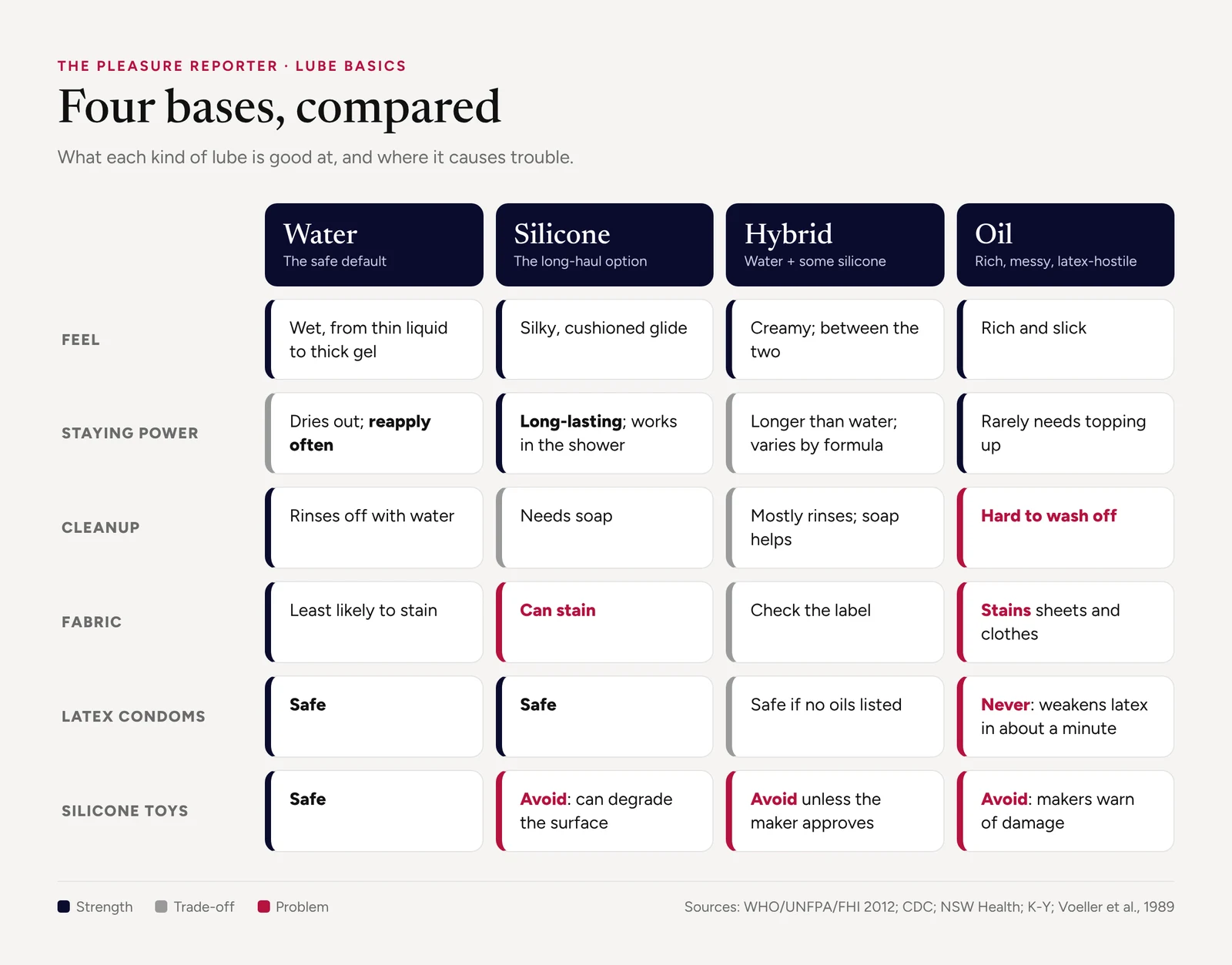
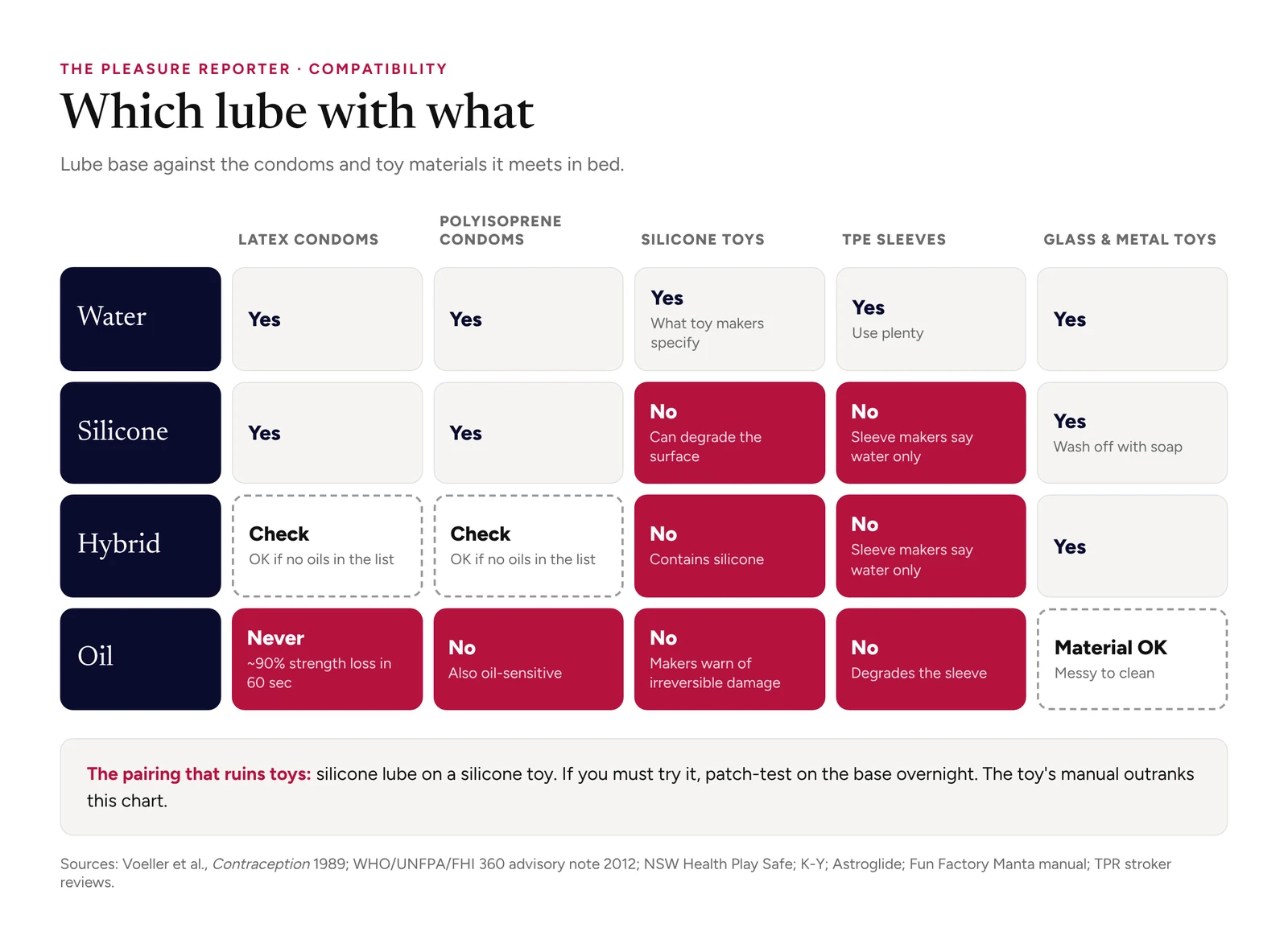
The short version: Water-based lube is the safe default for everything: every condom, every toy, every body. Silicone lasts longer and works in the shower, but keep it off silicone toys. Oil feels great and ruins latex condoms in about a minute. Hybrids sit in between and inherit silicone’s toy caveat. Skip numbing lubes unless you understand what you are giving up.
The four bases, in one sitting
Water-based
This is the everyday option and the one most toy manufacturers name in their manuals. NSW Health’s sexual health service puts it plainly: water-based lube works with sex toys and with all condoms. It washes off with water, it is less likely to stain fabric than silicone, and it is the base you can hand to someone without a compatibility lecture.
The trade-off is staying power. Water-based formulas dry out and need topping up, especially on long sessions or anything that moves a lot of surface area. Even K-Y, which sells both kinds, says water-based lube tends to wash off quickly and needs frequent reapplication. Thin ones feel like water; thick gels feel like hair product. Neither is wrong. It comes down to what you are lubricating.
Silicone-based
Silicone lube is the long-haul option. It is not water-soluble, so it survives the shower and does not need reapplying as often as water-based. The feel is silky rather than wet, closer to a cushion than a splash. It is also compatible with latex, non-latex and polyurethane condoms, per NSW Health, and the WHO describes silicone oils as inert with minimal effect on latex film.
The costs: it does not rinse off with water alone (you need soap), it can stain fabric, and it has a well-documented feud with silicone toys. More on that in a minute, because it is the headline of this piece.
Hybrid
Hybrids mix a water base with some silicone to get a creamier glide that lasts longer than plain water-based and cleans up more easily than pure silicone. Formulations vary a lot, so treat “hybrid” as a description, not a spec. Two practical rules follow from the ingredients. Because there is silicone in it, treat a hybrid like silicone lube around silicone toys unless the toy maker says otherwise. And because some “hybrid” or “natural” blends add plant oils, read the ingredients before using one with a latex condom.
Oil-based
Oil is the oldest lubricant in the house and the most persuasive. It lasts, it rarely needs reapplying, and it feels rich. It also stains sheets and clothing, it is a nuisance to clean, and it degrades latex condoms. NSW Health says flatly to never use oil-based lube with latex condoms and suggests keeping it for solo use. Coconut oil, baby oil, petroleum jelly and body lotion all count as oil here, no matter how “natural” the jar claims to be.
The one pairing that will destroy your toy
Silicone lube on a silicone toy. That is the pairing on the card, and it is the one every major source agrees on. K-Y says silicone lube is “not safe to use with silicone sex toys” and recommends water-based instead. Astroglide, which also sells silicone lube, says silicone-based lubricants do deteriorate softer sex toys and points silicone lube at hard materials like glass and steel. NSW Health warns that the silicone in the lube can break down the surface of the toy over time.
The toy makers are blunter still. Fun Factory’s manual for the Manta tells you not to use silicone-based lubricant, oils or lotions with the toy, lists coconut and edible oils by name, and says they can cause irreversible damage that is not covered by warranty. In our Domi 2 review we used only water-based lube for exactly this reason: the failure mode is a tacky, dulled patch on the surface that washing does not lift.
A toy ruined by the wrong lube does not break. It just turns slightly sticky, forever.
You will see people online say that high-grade, platinum-cured silicone shrugs off silicone lube. Some may. But “some may” is not a manufacturer guarantee, and the manufacturer is the one holding your warranty. If you want to try anyway, do a patch test on a part of the toy that never touches skin, such as the base. Leave a dab overnight, wash it off, and check for tackiness, swelling or a change in sheen. A pass tells you about that toy and that lube only. A fail tells you everything you need.
The second offender is oil on soft sleeves. TPE, the stretchy material most stroker sleeves are made of, is a finite material that wears with use, and every TPE stroker we have reviewed lists water-based lube only. Our Tenga Flip Zero review also flags warming agents as worth skipping on a sleeve. If you want the material science behind why the two plastics behave differently, our TPE vs silicone explainer covers it.
Condoms and the sixty-second problem
The oil-and-latex warning is not folklore. In a 1989 study in Contraception, researchers exposed latex condoms to mineral oil and found that as little as sixty seconds of contact cut burst volume by roughly 90% in the standard ISO air-burst test. Baby oil and a popular mineral-oil hand lotion also affected condom integrity. In the same study, five minutes of glycerol exposure did not significantly change burst volume or pressure, which is why water-based lubes with glycerin are condom-safe.
The CDC’s condom guidance says the same thing in plain English: use water-based lubricants, because oil-based ones such as petroleum jelly and body lotion can weaken latex and break the condom. The WHO adds a detail people miss: polyisoprene condoms, the common latex-free option, are also sensitive to oil-based lubricants. So “latex-free” does not mean “oil-proof.” If you are not sure what your condom is made of, the box will tell you, and the answer decides the bottle.
Silicone lube is fine with latex, polyisoprene and polyurethane condoms. Water-based lube is fine with all of them. If you are bringing a toy and a condom into the same bed, water-based keeps every item in play at once, which is a large part of why it is the default. Our guide to bringing a toy into bed covers the rest of that conversation.
Reading the back of the bottle
Most lube labels are written to be skimmed. A few terms deserve a slower read.
Osmolality
Osmolality is a measure of how concentrated a liquid is. If a lube is far more concentrated than the cells it touches, it draws water out of them, which can irritate or damage the delicate lining of the vagina or rectum. In 2012 the WHO, with UNFPA and FHI 360, published an advisory note on lubricants used with condoms. It says osmolality should ideally not exceed 380 mOsm/kg to minimize the risk of epithelial damage, and it set an interim procurement limit of 1,200 mOsm/kg.
Most consumer products sit well above the ideal. A 2014 study in Pharmaceutics measured 12 commercial vaginal gels and found osmolality between roughly 977 and 3,797 mOsm/kg. None met the 380 ideal, and seven exceeded 1,200. The European version of K-Y Jelly measured about 3,631. Brands rarely print osmolality on the bottle, so the practical move is to look for it on the manufacturer’s site, and treat a figure close to 380 as a selling point.
Glycerin
Glycerin (glycerol) is a humectant that keeps water-based lube slick. It is also the main driver of high osmolality. The WHO note recommends keeping glycerol at or below 9.9% of the formula, and propylene glycol at or below 8.3%, to stay under the 1,200 limit. Glycerin is not poison and it does not hurt condoms. It is simply the ingredient most worth checking if you have had irritation before.
pH
The WHO note recommends a pH of about 4.5 for vaginal lubricants and 5.5 to 7 for rectal use, and says lubricants above pH 7 are not recommended. If a lube is going to be used for both, or you do not know, the 5.5 to 7 window is the WHO’s advice for undetermined use.
Preservatives and the rest of the list
Anything with water in it needs a preservative, and parabens are the most common choice. The WHO notes preservatives can cause irritation and sensitization in some people but makes no specific ruling on parabens. Denmark’s Consumer Council tested 31 lubes in 2020 and gave its lowest rating to six of them: two contained parabens and two used cyclopentasiloxane, a silicone it flags as a suspected endocrine disruptor. Two ingredients carry firmer warnings. The WHO says to avoid lubes with polyquaternium compounds until there is more evidence on how they affect HIV replication, and it does not recommend nonoxynol-9, the spermicide, because of its irritant effects.
Warming, tingling and numbing
“Enhanced” lubes are where marketing does most of the talking. Warming and tingling formulas get their effect from added ingredients, and those ingredients are the part most likely to irritate. A Canadian sexual health clinic notes that some users report irritation, numbing or burning from these products, the opposite of what the label promised, and suggests testing on a less sensitive patch of skin first. That is sensible advice for anything new.
Numbing lubes deserve a firmer line. In the US, over-the-counter “male genital desensitizers” are covered by an FDA monograph: benzocaine at 3 to 7.5% in a water-soluble base, or lidocaine in a metered spray. Their required label warnings include a rash-or-irritation warning for “you or your partner” and a note that premature ejaculation may be due to a condition requiring medical supervision. In other words, the numbing does not stay on you, and it is a symptom treatment, not a fix.
The bigger concern is what numbing removes. Pain and stinging are how your body tells you something is too fast, too dry or too much. Masking that signal during anal sex or rough play takes away the warning without removing the cause. If you are reaching for desensitizers to last longer, the techniques in our piece on stamina, sleep, breath and the pelvic floor address the cause. See a doctor if early ejaculation is persistent and bothering you or a partner, or if any lube leaves you with burning, swelling or a rash that does not settle within a day or so.
How much, and for what
No authority publishes a milliliter figure, and anyone who does is guessing. The workable rule is to start with more than you think and add before you need it, not after. A quarter-sized amount warmed between your palms is a reasonable opening bid for hand or partnered use. With a condom, a few drops on the outside (and a drop inside the tip) reduce friction on the latex itself.
Strokers
Sleeves are the thirstiest thing you will ever lubricate. In our Lovense Max 2 review we found the TPE sleeve drinks lube and needed reapplying several times on longer sessions; the Flip Zero did the same. Use water-based, use plenty, put some inside the sleeve as well as on you, and warm the bottle in a mug of warm water first. Cold lube in a cold sleeve is a poor first impression, and in the Flip Zero review we found warming it first made a large difference.
Vibrators and wands
External vibrators need less, but body-safe silicone drags when dry. We found the Fun Factory Manta’s flexible wings worked best with a generous amount, and dragged without it. Water-based is the default here because almost every vibrator worth owning is silicone.
Partnered sex
Here the decision is mostly about condoms and how long you plan to be at it. Water-based works with everything and cleans up easily. Silicone lasts longer and survives the shower, and is condom-safe. If there is a silicone toy in the mix too, water-based avoids having two bottles open. Anal sex calls for more lube than you think, and for topping up before anyone has to ask.
Storage, shelf life and the sheets

Lube has an expiry date for a reason. The preservatives in a water-based formula are what keep it from growing things, and they do not last forever. Check the printed date, or the open-jar symbol if there is one,, and replace anything that has changed color, smell or texture. Keep the cap closed, keep it out of a hot car, and do not top up an old pump bottle with a new one. A dedicated bottle beats a shared kitchen jar for the same reason: fingers go in, bacteria come out.
Fabric is the other casualty. Water-based lube is the least likely to stain. Silicone can stain fabric, which is the price of its staying power. Oil stains sheets and clothes and is the hardest to get out. A dark towel on the bed costs nothing and saves the argument.
Clean your toys after every use, with the lube still in mind. Water-based rinses away with warm water and mild soap. Silicone needs soap and a little more effort. For TPE sleeves, flushing out lube completely and drying the sleeve thoroughly matters more than anything else; our guide to cleaning a TPE sleeve walks through it.
Quick answers
Does a pre-lubricated condom still need lube?
Usually, yes. The coating on a condom is a thin film meant to help it unroll and survive the first minutes. Island Sexual Health, a Canadian clinic, advises adding a few drops to the outside and inside of the condom. Use water-based or silicone, never oil, and add more as you go.
Can I use silicone lube with a glass or metal toy?
Yes. Hard, non-porous materials such as borosilicate glass and stainless steel do not react with silicone lube, and Astroglide specifically points silicone lube toward hard materials. Wash it off with soap afterward, since water alone will not shift it.
Is coconut oil safe if I am not using condoms?
For the toy and the condom question, the answer is still no for latex, polyisoprene and most toys. For bodies, Healthline points to a 2013 study that linked oil-based lubricants to higher rates of yeast infection in women. If you use it for solo hand use, use a separate, clean jar, not the one you cook from.
Does the lube that comes with a toy matter?
Usually it is a small water-based sachet or bottle, chosen to match the toy, so it is a safe first pick. It is often a token amount, though. When it runs out, buy another water-based lube rather than whatever is closest.
Why does my lube feel sticky after a few minutes?
Water-based lubes lose water as you use them, and what is left (often glycerin or thickeners) turns tacky. A few drops of water or a little more lube will bring it back. If stickiness is a constant complaint, try a silicone or hybrid formula, compatibility permitting.