Scent Strategy: Three Fragrances, Three Kinds of Night
A fresh one for the first date, a warm one for the second, and the one you only wear at home.
Most men own one fragrance. It was a gift, or it was on sale at the airport, and it now gets worn to job interviews, funerals, beach weddings and the gym with the same blind loyalty. That’s not a crime. It’s just a missed opportunity, like owning one pair of shoes and wondering why they never feel right in the snow.
A small fragrance wardrobe fixes this without turning you into the guy with forty bottles and opinions about oud. Three is the number. One bright and clean for when you’re still being judged on first impressions. One warmer and deeper for when the evening has stopped being an audition. And one so quiet that only someone standing inside your personal space will ever know it’s there.
This guide covers what each of those three smells like on paper, when to reach for it, how many sprays and where, what the words on the bottle actually mean, and how to test a scent before you commit. It also covers what the science says about smell and attraction, which is more interesting than the marketing and considerably less magical.
The short version: Build three scents: a fresh citrus-aromatic for first meetings, a warm amber-woody for later dates, and a close-to-skin musk for home. Start light (two to four sprays depending on strength), spray skin or clothes rather than the air, and test on your own skin for a full afternoon before buying. Skip anything sold as a “pheromone” cologne; the research doesn’t back it.
Why three, and why it matters at all
Smell has an unusual line into memory. In a 2002 study in the American Journal of Psychology, Rachel Herz and Jonathan Schooler found that memories triggered by an odor were rated as more emotional than memories triggered by the same cue shown as a picture or a word, and people felt more “brought back” to the original moment. That’s a lab finding about memory, not a promise that someone will fall for you over a whiff of bergamot. But it’s a decent argument for wearing something deliberate on a night you’d like remembered.
The more useful finding is about you. In a double-blind study published in the International Journal of Cosmetic Science in 2009, researchers gave men either a fragranced spray or an identical one with the fragrance and antimicrobial ingredients removed. The men using the real thing reported higher self-confidence. Then a panel of women rated the men. In still photos, there was no difference. In short video clips, watched with no smell present at all, the scented group was rated more attractive. The authors’ reading: the fragrance changed how the men carried themselves, and that showed up on camera.
The best thing a good fragrance does for your date is change how you walk into the room.
Which is the case for three bottles instead of one. A scent that suits the occasion is one less thing to feel off about. A heavy amber at a noon coffee date makes you self-conscious; a sharp citrus at a candlelit dinner feels like you came straight from the office. Match the bottle to the night and you can stop thinking about it, which is the point.
The fresh one: for the first date
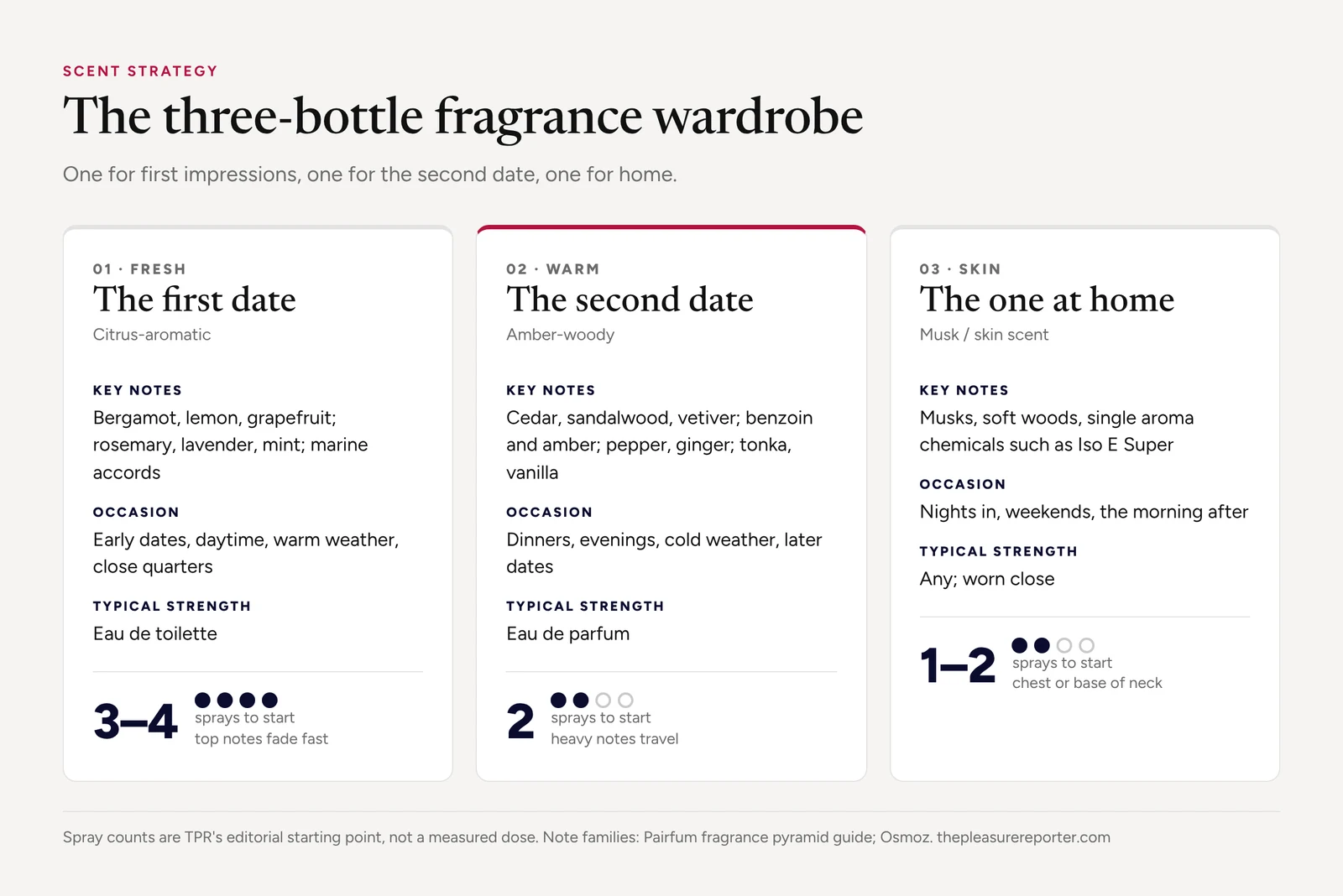
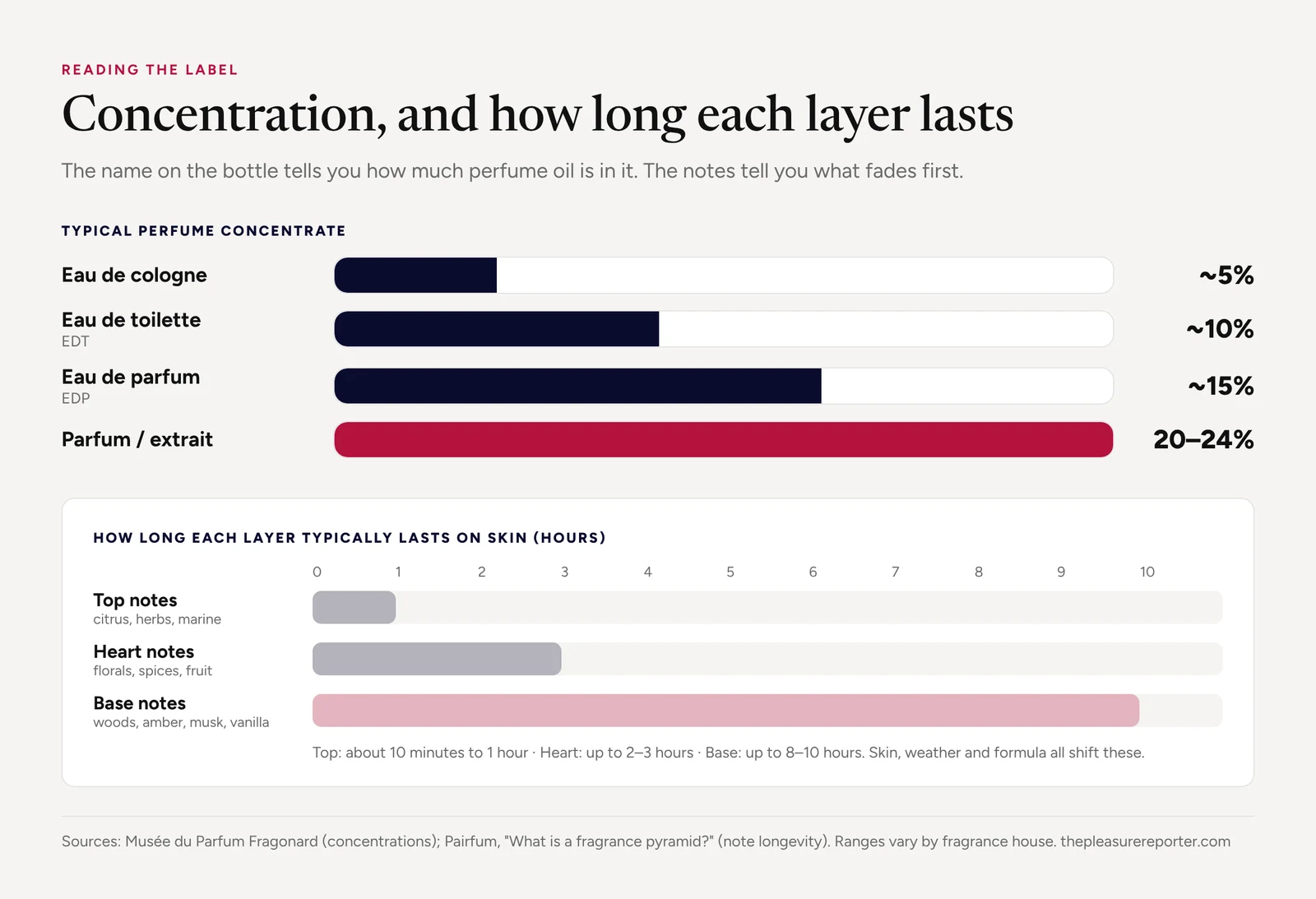
The first-date scent lives in the citrus-aromatic family. Think bergamot, lemon, grapefruit, orange, plus aromatic herbs like rosemary, lavender or mint, and sometimes a “marine” accord meant to suggest sea air. These are the most volatile materials in perfumery. They hit hard in the opening and fade fastest; top notes like these typically last somewhere between ten minutes and an hour before the heart of the scent takes over.
That fast fade is a feature for a first date. You want to come across as clean, awake and easy to be near, not as a weather system. A fresh scent says you showered and made an effort without saying you’ve been planning this since Tuesday. It also works in daylight, in a crowded bar and in a small car, which covers most first-date geography.
A well-known example: Giorgio Armani’s Acqua di Giò Eau de Toilette, which Armani lists as opening on marine notes and bergamot, with jasmine, cedarwood and rosemary in the heart and white musks and patchouli in the base. Note the structure. Even a famously fresh scent sits on a woody, musky base, which is what keeps it from vanishing entirely by the time you’ve ordered drinks.
When: first and early dates, daytime plans, warm weather, anything involving close quarters with strangers. Strength: usually an eau de toilette. Our starting point: three to four sprays of an EDT, because the bright top notes burn off quickly and a little extra keeps the base in play. If you’re sitting knee to knee in a booth, drop to two.
The warm one: for the second date
By the second date you’ve passed the screening. The warm scent can afford to be richer, slower and more personal. This is the amber-woody territory: woods like cedar, sandalwood and vetiver, resins and balsams like benzoin and amber accords, spices like pepper and ginger, and sweeter base materials like tonka bean and vanilla. These are heavier molecules. They evaporate slowly, and base notes in this family can hang around for up to eight to ten hours on skin.
Heavier notes also travel. Musk, amber, wood and vanilla leave a longer trail than light citrus or florals, which is exactly why this scent belongs to evenings and cooler weather, and exactly why you need a lighter hand with it.
Two well-documented examples sit at either end of the family. Terre d’Hermès, created by Jean-Claude Ellena in 2006, is classified as woody-spicy: orange, grapefruit and a mineral “flint” note up top, then pepper, patchouli and geranium leaf, drying down to benzoin, vetiver and Atlas cedar. It’s the warm scent for men who don’t like sweet. At the other end, Tom Ford’s Tobacco Vanille lists tobacco, ginger and spices on top, tonka bean, tobacco flower, cocoa and vanilla in the middle, and woody sap with a dried-fruit accord at the base. That one is dessert. It needs a cold night and a restrained arm.
When: second and later dates, dinners, cold-weather evenings, the kind of night that might move from the restaurant to somewhere else. If it might end in a hotel, our guide to the hotel-room aphrodisiac covers the rest of the setting. Strength: usually an eau de parfum. Our starting point: two sprays. Seriously, two.
The skin scent: the one you only wear at home
The third bottle isn’t for impressing anyone across a room. It’s for the person who already gets close: on the couch, in bed, at breakfast the next morning. Skin scents lean on musks, soft woods and modern aroma chemicals that sit low and close, so they smell less like perfume and more like a better version of you.
That last bit has some science behind it. A 2015 study in Frontiers in Psychology found that people could still tell individuals apart by body odor when fragrance was applied, and that discrimination was better when donors wore a product they had chosen themselves than one they were assigned. Earlier work from the same research group suggests people tend to pick fragrances that complement their own body odor, producing a blend rather than a cover-up. The studies were small and used deodorants rather than perfume, so treat this as a direction, not a law. But it’s the logic of the skin scent: you’re not masking yourself, you’re adding a layer that works with what’s there.
The most famous example is almost a dare. Escentric Molecules’ Molecule 01 is, per the maker, 100% Iso E Super, a single synthetic aroma chemical and nothing else. There’s no top note to fade and no traditional pyramid. What you smell is that one material sitting on your skin, which is why it’s a fixture in conversations about scents that seem to change from wearer to wearer.
When: lazy weekends, nights in, the morning after (we wrote a whole piece on doing the morning after properly). Our starting point: one or two sprays, chest or base of the neck. If you can smell it clearly from arm’s length, you’ve overdone it.
How much, and where to put it
Three terms are worth knowing. Projection is how far the scent reaches when you’re standing still in front of someone. Sillage, from the French for “wake,” is the trail you leave when you move. Longevity is simply how long it lasts. A good date scent has modest projection, a short sillage and decent longevity: present when someone leans in, gone by the time you’ve walked past the next table.
The single biggest mistake is over-spraying, and it has a biological cause. Your nose habituates to smells fast. A 2017 review in Physiology & Behavior describes the decline in perceived intensity under steady exposure as relatively quick. Translation: twenty minutes after you spray, you can barely smell yourself, and everyone else can smell you fine. Respraying because you “can’t smell it anymore” is how men end up announcing themselves from the elevator.
Where to apply:
- Warm spots on skin: the sides of the neck, the base of the throat, the chest, inner wrists. Body heat helps the scent rise.
- Clothing: fabric holds fragrance well and boosts the trail. A spray on the inside of a jacket or on a scarf lasts. Test on a hidden seam first if the fabric is delicate or pale.
- Not the air: the spray-and-walk-through-the-mist move wastes most of the bottle on your floor.
On rubbing your wrists together: the warning that it “crushes the molecules” is a myth. Friction can’t crush anything at a molecular level. The heat may speed up the lightest top notes a little, and in one informal comparison by the fragrance writer behind Bois de Jasmin, perfumers couldn’t detect a dramatic difference between a rubbed and an unrubbed arm after fifteen minutes. Press if you want. Just don’t make it a ritual.
Moisturized skin tends to hold scent better than dry skin, so applying after a shower and an unscented lotion helps. And if what you’re wearing is the first thing anyone notices, the scent is fighting your clothes for attention; our guide on how to dress for the undressing handles the other half of that equation.
EDT, EDP, parfum: what the label actually says
The words on the bottle describe concentration: how much perfume oil is dissolved in the alcohol. Exact figures vary by fragrance house, but the Fragonard perfume museum in Paris gives these typical ranges:
| Label | Typical perfume concentrate | Best for |
|---|---|---|
| Eau de cologne | About 5% | A quick refresh; fades fast |
| Eau de toilette (EDT) | About 10% | Fresh scents, daytime, first dates |
| Eau de parfum (EDP) | About 15% | Warm scents, evenings |
| Parfum / extrait | About 20–24% | Small doses, close wear |
Higher concentration generally means a scent lasts longer and you need less of it. It doesn’t automatically mean it’s louder; the materials matter as much as the percentage. A fresh EDT built on citrus may be gone in a couple of hours, while a musky skin scent at the same strength can sit on you all day without ever projecting more than a few inches.
When a scent comes in both EDT and EDP, don’t assume the stronger one is simply the same thing turned up. Houses can adjust the formula between versions, so test the exact bottle you plan to buy.
Pheromone colognes: save your money
Somewhere online, a bottle promises that its secret ingredient will make women find you irresistible on a biological level. The research doesn’t support this, and the people who study it have been unusually blunt.
In a 2015 review in Proceedings of the Royal Society B, zoologist Tristram Wyatt argued that decades of human pheromone research had been built on weak foundations. The steroid molecules most often named as candidates, such as androstadienone, were chosen without the bioassays that would show they actually trigger a response in humans. They do act as pheromones in pigs, and they do turn up in human armpit sweat. That’s not the same thing. His conclusion was that the field needed to start again from first principles.
A 2017 study in Royal Society Open Science then tested the two best-known candidates directly. Researchers at the University of Western Australia exposed 94 heterosexual participants to androstadienone, estratetraenol or a control scent, double-blind, and had them rate opposite-sex faces. Neither compound affected attractiveness ratings, judgments of how likely someone was to be unfaithful, or even whether a gender-neutral face looked male or female.
None of this means smell is irrelevant to attraction. Body odor does carry information, and people do respond to it. It means no one has found a molecule you can bottle that flips a switch in someone else. The effect that has been measured runs through your own confidence, which any fragrance you genuinely like can deliver.
How to test a scent, and how to keep it alive
Buying fragrance off a paper strip is like buying jeans off the hanger. Paper is fine for narrowing a shortlist. Skin is the real test, because your skin chemistry and body odor shape how a scent develops, and the research on self-chosen fragrances suggests your own nose is the best judge of what suits you.
- Shortlist on paper. Smell no more than three or four strips in a session. Your nose tires quickly and everything starts to blur.
- Pick one, maybe two, for skin. Spray a clean, unscented spot, such as the inner forearm. One scent per arm, maximum.
- Wait for the alcohol to evaporate before you judge. Sniffing the wet spray tells you mostly about ethanol.
- Leave the store. Live with it for the afternoon. The opening lasts minutes; the base is what your date will actually smell. Check it at one hour and again at four.
- Get a second opinion from someone whose nose you trust, ideally the person you’re planning to wear it around.
If a scent leaves redness, itching or a rash where you sprayed it, stop using it. Fragrance allergy is a form of allergic contact dermatitis that affects an estimated 1–2% of people, tends to be lifelong and can get worse with repeated exposure. See a doctor or dermatologist if a reaction spreads, keeps coming back, or shows up on your face or eyelids; patch testing can pin down the culprit.
Once you own the bottles, keep them out of the bathroom. Heat, humidity and light all break fragrance down, and the bathroom delivers all three daily. A drawer or closet that stays at an even temperature is ideal, and the original box is a perfectly good light shield. Don’t shake the bottle, and keep the cap on. If you travel with one, a small refillable atomizer saves the main bottle a trip through the airport; our discreet travel kit guide has the packing details.
Three bottles, stored properly and worn with restraint, will outlast years of impulse buys. The fresh one gets you through the door. The warm one makes the evening feel like an occasion. The quiet one is for the person who’s already decided they like you, and who’ll notice it on the pillow.
Quick answers
Can I wear the same fragrance on every date?
Yes, and some people deliberately do, so the scent becomes associated with them. The trade-off is fit: a heavy amber in July or a thin citrus on a January night will feel wrong to you, and that self-consciousness is the bigger cost. If you only buy one, choose something in the middle, such as a woody scent with a citrus opening, in eau de toilette strength.
Should cologne go on before or after deodorant?
Deodorant first, then let it dry, then fragrance. Choose an unscented or very lightly scented deodorant if you can, so the two products aren’t competing. A strongly scented body spray layered under a real fragrance usually smells like two people arguing.
Does fragrance expire?
There’s rarely a printed expiry date to go by. Fragrance breaks down gradually with heat, light, humidity and air, and the fragile citrus top notes tend to go first, so a fresh scent that suddenly opens flat or sour has probably turned. The fix is prevention: cool, dark, capped and out of the bathroom.
Is it rude to wear fragrance to a restaurant?
Not if you keep it close. Food and wine are part of what people are paying for, and a scent that reaches the next table interferes with that. Stick to one or two sprays of anything strong, apply it at least half an hour before you sit down, and leave the heaviest gourmands for nights that don’t revolve around dinner. For the rest of the table etiquette, see our guide to ordering like you’ve been here before.
Do I need to spend a lot for a good skin scent?
No. A higher price buys you branding and packaging at least as much as it buys better materials, and plenty of simple musk-based scents sit at the cheap end of the shelf. What matters is how it wears on your skin over four or more hours, which is why sampling beats reading reviews. Buy a small decant or travel size before a full bottle if one is available.