Order Like You’ve Been Here Before
The date-night bar playbook: where to sit, what to order, when to leave.
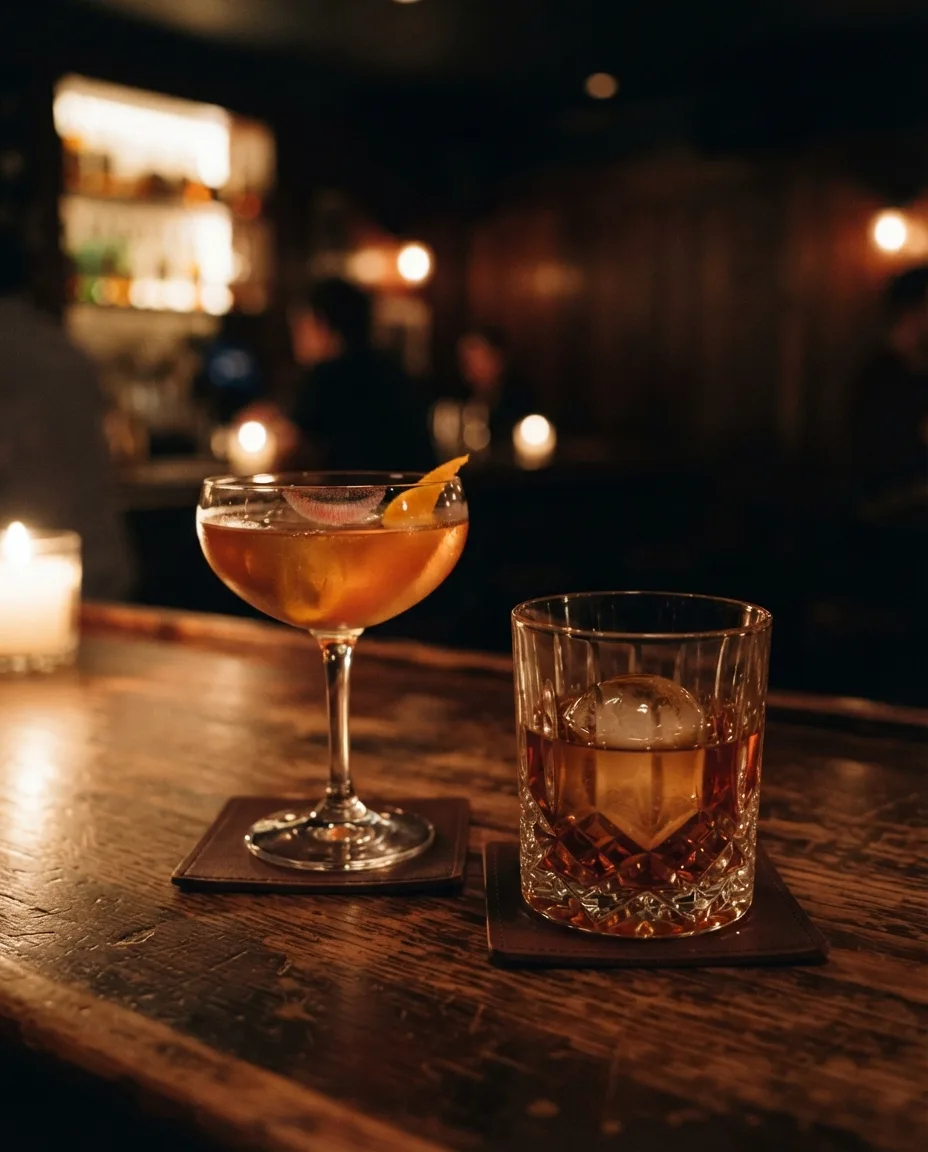
A first drink with someone you like is a small piece of theater, and you are both the lead and the stagehand. You picked the venue, so the venue is now a reflection of you. The stool wobbles, the music is a wall, the menu is laminated and sticky: that is all on your account, fairly or not. The good news is that the whole production runs on a handful of decisions you can make before you leave the house.
This is the playbook for those decisions. Where to go, where to sit, how to talk to the person behind the bar, what to order and what the order quietly says about you, how fast to drink it, what the research says alcohol does to the rest of the evening, who pays, and the exact moment to stand up and get your coat. None of it requires knowing the difference between a Cognac and an Armagnac. It requires paying attention, which is the thing your date is actually grading.
The short version: Scout the bar in advance and pick somewhere you can hear each other. Sit at the corner of the bar or side by side, not across a big table. Order something you can name without squinting, have food with it, alternate with water, and stop at two. Alcohol in small amounts mostly loosens nerves; in larger amounts it measurably blunts arousal. Settle the bill without theater and leave while the conversation is still good.
Pick the bar before you pick the drink
The single best move happens days before the date: go to the place alone, or with a friend, on the same night of the week at roughly the same hour. A bar on a Tuesday at 7 p.m. and the same bar on a Friday at 10 p.m. are two different businesses. You want to know the volume, the crowd, the state of the bathrooms, and whether a quiet corner of the bar tends to stay open.
Three things matter more than décor. First, noise: if you have to lean in to hear the bartender, you will spend the night saying “sorry, what?” to your date. Second, light: dim is flattering and intimate, but you should be able to read the menu and see a face. Third, food: a bar with a real snack list (fries, olives, a cheese plate, anything) gives you a reason to eat, and eating changes how the alcohol lands, which we will get to.
A place where you can hear each other, the bartender knows the classics, and there is something to eat beats any rooftop with a line. If the night has a second act planned, choose a bar within a short walk of it, and keep a plan B in your pocket in case your first choice has turned into a birthday party.
Where to sit: bar, booth or the corner
The corner of the bar is the strongest seat in the house for a first or early date. Two stools that meet at the bend of the bar put you at a right angle to each other: close enough that knees can touch, angled enough that you are not locked in a stare-down. You both get a view of the room, which gives the conversation something to bounce off when it dips. You are also right in front of the bartender, which means faster drinks and a third party to laugh with.
Side by side at a straight stretch of bar is the next best thing. The trade-off is that you spend the night turning your head, and a talkative neighbor can take the stool on their other side.
The booth is better for a third or fourth date, or for a night with a lot to talk about. It is private and comfortable, but sitting directly across from someone turns a drink into an interview. If the booth is big enough, sit on the same side or at the corner of the table instead.
The two-top in the middle of the floor is the seat to avoid: servers squeezing past, and a candle between you like a hostage negotiation.
On sightlines: give your date the seat that faces the room or the better view, and take the one with your back to the door. Nobody wants to watch you watching the entrance.
The bartender is on your side
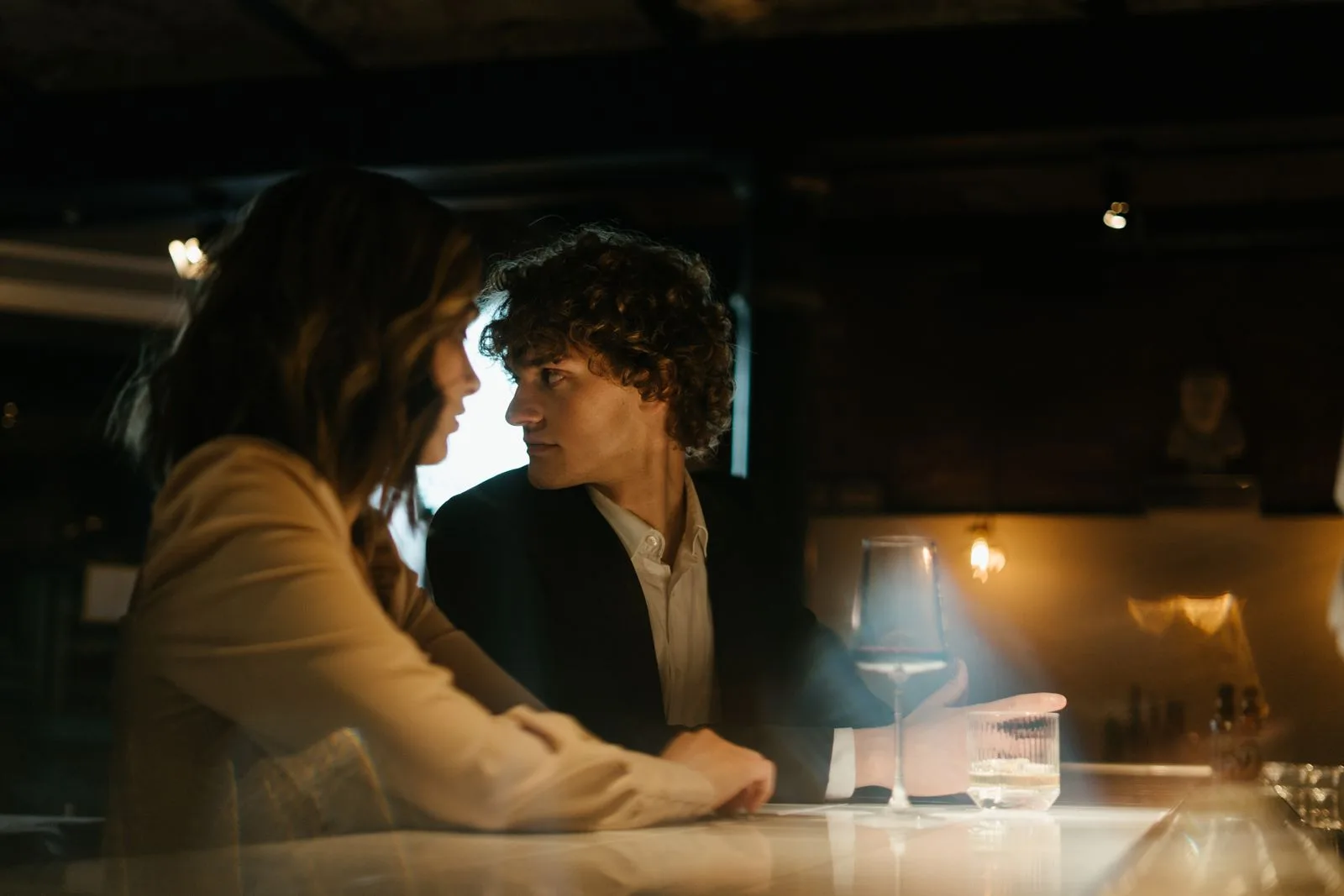
A good bartender wants your night to go well, if only because it makes theirs easier. Treat them like a professional on your team, not a vending machine.
Make eye contact and wait to be acknowledged instead of waving, tapping a card or calling out. When they arrive, have an answer ready, or ask one specific question. “What’s good here?” is a coin toss. “We like something on the bitter side, what would you make?” or “Is there a gin drink on the list you’d recommend?” gives them something to work with and shows you know what you want without pretending to know everything.
If you are unsure what a drink on the menu is, ask. Asking calmly is far more attractive than ordering blind and making a face at the first sip. If the place is slammed, keep it short.
If you are opening a tab, hand over the card early. It keeps the money out of the conversation.
A field guide to the classics
You do not need a big repertoire. You need two or three drinks you actually like and can order without hesitation, plus a rough sense of how strong they are. The chart below decodes a dozen classics using the official recipes from the International Bartenders Association, with an estimate of how much alcohol each holds compared with one US standard drink.
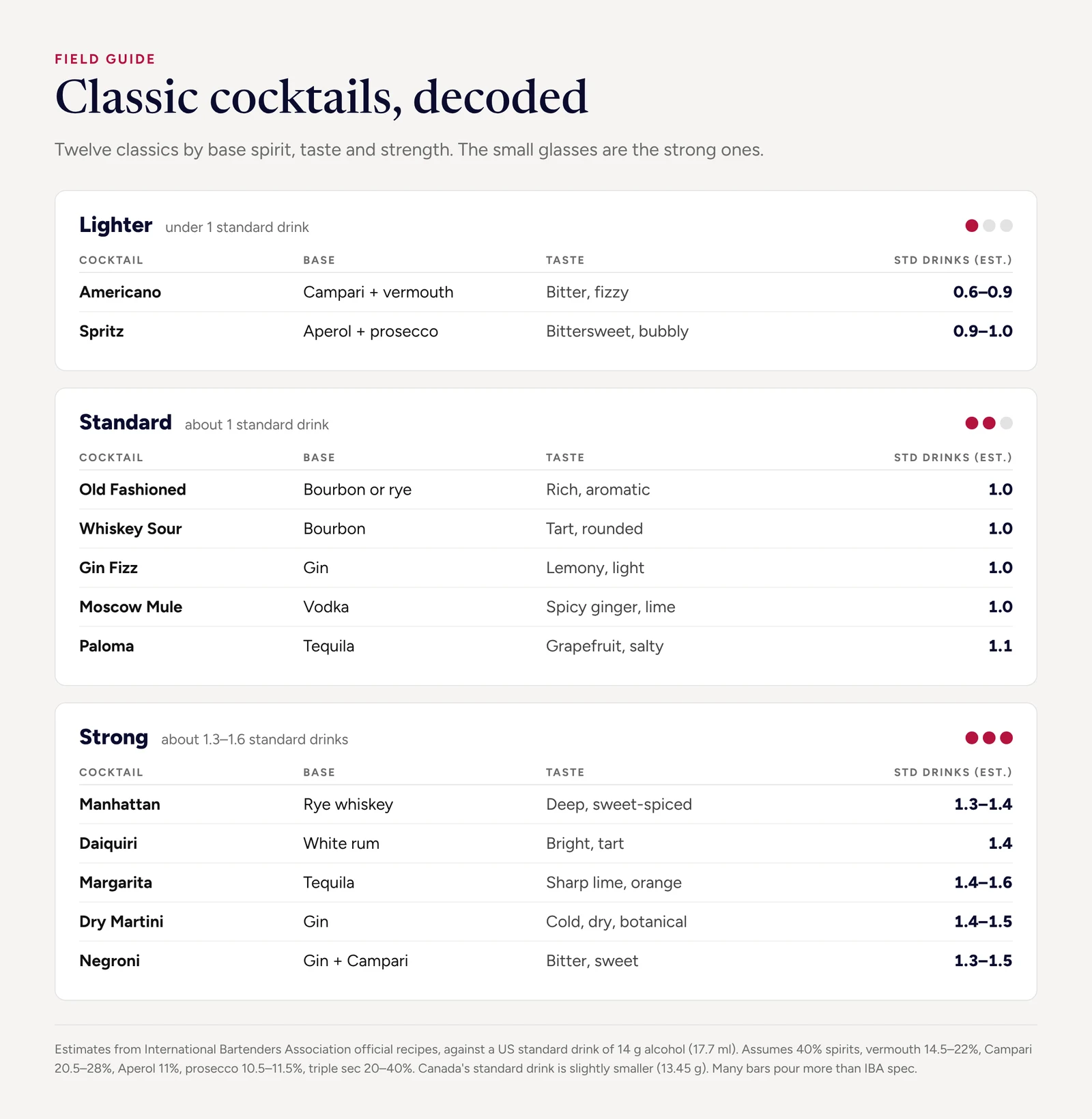
The lesson: the drinks that look small are the strong ones. A Martini, Manhattan or Negroni holds roughly one and a half standard drinks in a little glass, because it is almost all alcohol. The tall drinks with mixers sit at about one or under, and take longer to finish.
Stirred and spirit-forward
The Martini, Manhattan, Old Fashioned and Negroni are built from spirit plus vermouth, bitters or a little sugar, and stirred rather than shaken. They are aromatic, strong, and meant to be sipped. The Old Fashioned is the friendliest of the four (whisky, sugar, bitters) and almost any bar can make a decent one. A Negroni is equal parts gin, Campari and sweet vermouth: bitter, a little sweet, a very grown-up order. Order a Martini only if you genuinely like cold gin.
Sours
The Daiquiri, Margarita and Whiskey Sour are spirit, fresh citrus and something sweet, shaken hard. They are bright and easy to drink, which is exactly why they disappear quickly. A proper Daiquiri is not a frozen slushie; it is rum, lime and sugar, served up, and it is one of the best tests of a bar. The Whiskey Sour is a good choice if you like whisky but not the burn of drinking it straight.
Long drinks and the low-proof bench
Highballs and spritzes stretch a measure of spirit or a bitter aperitif with soda, ginger beer or sparkling wine. The Americano (Campari, sweet vermouth, soda) and the Spritz are the lightest classics on the chart and perfectly respectable first drinks.
Spirits on their own
If you would rather order a spirit neat or on the rocks, know your preferences in one sentence: “a bourbon, something on the softer side, with one ice cube” or “a mezcal, neat, whatever you like.” A 1.5 oz (about 43 ml) pour of a 40% spirit is one standard drink in both the US and Canada, so a neat pour is no stronger than a beer, just faster to finish if you are not careful. Sip it. A few drops of water is fine if it is fierce.
Wine by the glass
A 5 oz (roughly 142 to 148 ml) glass of 12% wine is one standard drink. Some bars pour more than that, and many wines are stronger than 12%, so a glass of a big red can be closer to one and a half. When ordering, describe what you like rather than performing expertise: “something dry and crisp, white,” or “a red that isn’t too heavy.” Ask to taste if you are torn between two; bars that pour by the glass will often give you a splash. If you are both drinking wine, a bottle is about five standard glasses, which is more than a two-drink evening for two people, so do the math before you commit.
Not drinking? Order with the same confidence
Plenty of people do not drink, or are not drinking tonight, and the right way to handle it is to make it a complete non-event. If that is you, order exactly like everyone else: clearly, with a specific request. Some bars now have a zero-proof section on the menu. If they do not, ask the bartender to build you something along the lines of a drink you like: “something tart and citrusy, like a sour, without alcohol” or “something bitter and fizzy.” A good bar can work with fresh citrus, syrups, tonic and soda. A nicely made soda water with lime in a proper glass also does the job, and nobody needs an explanation.
If your date is the one not drinking, follow their lead and do not make a thing of it. Do not ask why, do not apologize for ordering a drink, do not suggest “just one.” Choosing a bar with a real zero-proof list is a thoughtful touch.
Pacing a two-drink evening
Two drinks is the right ceiling for a date where you want to remember the conversation and still be useful later. It also lines up with Canada’s current guidance, which sets a limit of no more than two standard drinks on any day, while noting that the lowest-risk number over a week is lower still. The trick is making two drinks fill two and a half hours without looking like you are rationing.
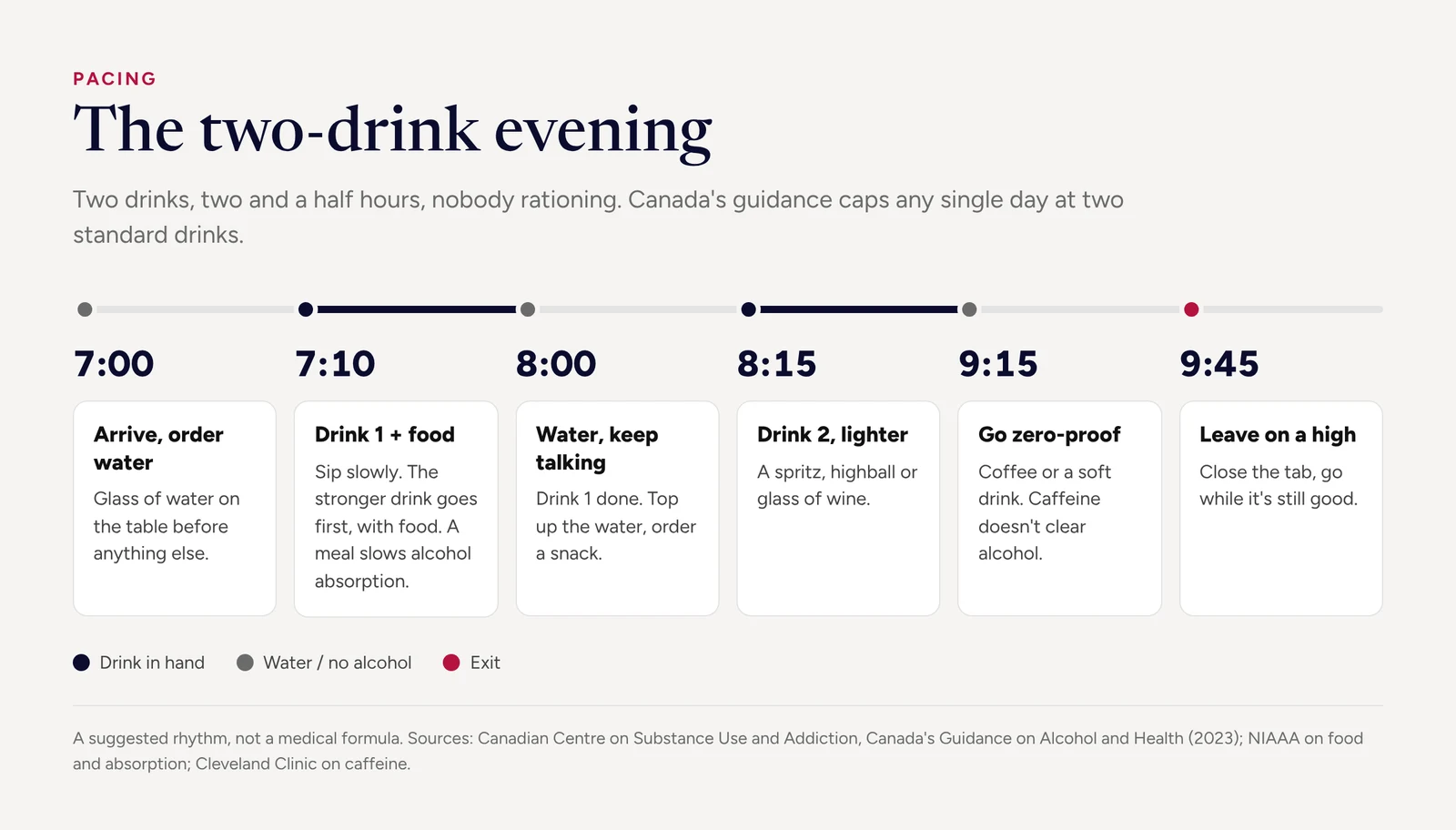
Start with food on the way or on the table. A US National Institute on Alcohol Abuse and Alcoholism summary reports that people who drank after a meal with fat, protein and carbohydrates absorbed alcohol about three times more slowly than on an empty stomach. Food does not make your liver work any faster, though, so it buys you time, not immunity.
Order a glass of water with the first drink and keep it topped up. Make the first drink the stronger one if you want something stirred and spirit-forward, then go lighter for the second: a Spritz, a highball or a glass of wine. Put the glass down between sips.
When the second drink is finished, switch to something without alcohol. Coffee is a nice end note, but do not mistake it for a reset: Cleveland Clinic points out that caffeine can make you feel less intoxicated without clearing the alcohol any faster, which is how people lose count.
What alcohol actually does to arousal
Shakespeare got there first. The porter in Macbeth says drink “provokes the desire, but it takes away the performance,” and the laboratory has mostly agreed with him for about fifty years.
In a 1976 study in Psychopharmacology, Rubin and Henson measured erectile response in 16 men watching erotic films after low, moderate and high doses of alcohol. Even the low and moderate doses produced a small but significant drop in average arousal. The high dose cut every measure of evoked arousal by a large margin. A 2006 study by George and colleagues in Experimental and Clinical Psychopharmacology found that a target blood alcohol level of 0.10% reduced peak erectile response compared with sober men, while a level of 0.08% mostly changed how quickly men responded, not how much. The authors described the effects in young moderate drinkers as small but detectable.
A drink or two can quiet the nerves. Past that, you are trading confidence for performance, and the exchange rate is poor.
The research on women points the same way. A 2011 paper in Hormones and Behavior by the same research group found that a 0.10% blood alcohol level reduced genital arousal in women, even though earlier studies often showed alcohol raising how aroused women said they felt. In plain terms: alcohol can make both of you feel more up for it while making both bodies respond less. The same paper notes an older study that found no such effect in sleeping men, which suggests some of the drop is psychological rather than purely mechanical.
Be honest about the limits of this evidence. These are small lab studies in young, healthy volunteers, measuring arousal in a lab rather than in a bedroom. They do not tell you exactly where your personal line sits. They do consistently show the direction: low amounts have small effects, higher amounts blunt arousal clearly. The NHS lists drinking too much alcohol as a common cause of occasional erection problems, and advises seeing a doctor if erection problems keep happening, since recurring trouble can point to a treatable health issue. If nerves rather than alcohol are your usual problem, our guide to stamina, sleep, breath and the pelvic floor is the better place to start than a third drink.
Consent also needs a clear head on both sides. If either of you is past the point of judging what you want, the evening is over for anything beyond a ride home.
The bill, and when to leave
Money should be dealt with quickly and without speeches. If you asked, the default is that you pay, and you say it simply: “I’ve got this, I invited you.” If your date offers to split or get the next round, accept graciously; arguing over the check is the least attractive two minutes of any evening. If you opened a tab earlier, you can close it quietly when one of you goes to the restroom, which removes the awkward moment altogether.
Tip as you would on any night out in Canada or the US, where tipping bartenders is customary, and a little more if the bartender went out of their way for you. Check the bill for the right number of drinks, sign, and put the card away.
Now the hardest call of the night: leaving. The instinct is to stretch a good evening. Resist it. Psychologists describe a pattern called the peak-end rule: people tend to remember an experience by its most intense moment and by how it ended, rather than by its total length. Most of that research involved short unpleasant experiences, not dates, so treat this as a sensible hunch backed by some science rather than a law. Still, it points the right way. Leave when the conversation is good, not after it has gone flat over a third drink neither of you wanted.
The signals are usually obvious: the second drink is finished, the bar is getting louder, a silence feels comfortable rather than awkward. That is your moment. Suggest a walk, the next spot, or simply say you have had a great time and want to do this again. If the night is moving somewhere more private, a little preparation helps; see how to set up a hotel room and what to wear for the undressing. And if it is not, there is always the morning after, done right, for whenever that comes.
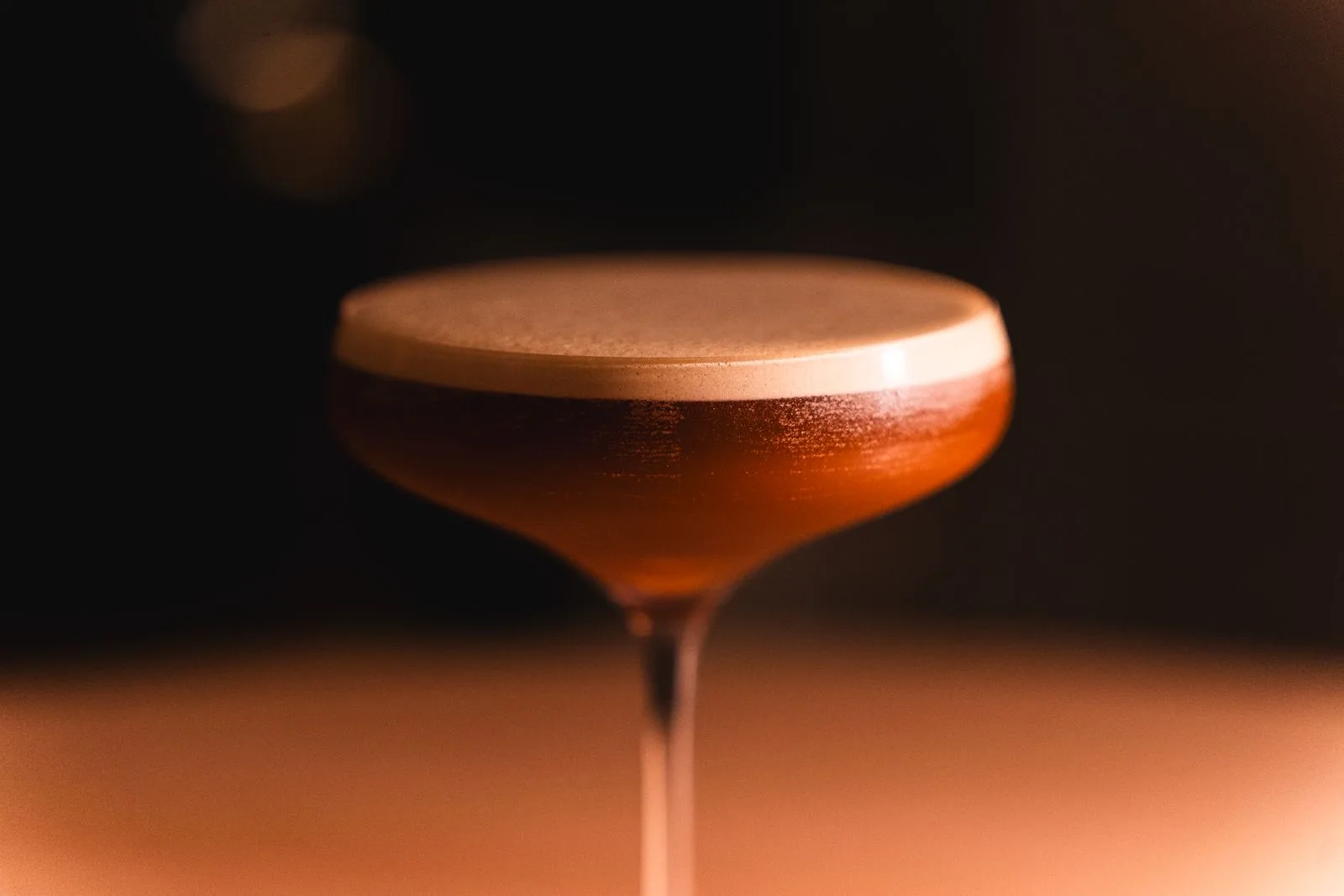
Order like you have been there before, and leave like you are coming back.
Quick answers
Is it rude to order a non-alcoholic drink on a date?
No. Order it the same way you would a cocktail, with a specific request, and say nothing more about it. If you want to avoid repeated offers, pick a drink that looks like a cocktail, such as a zero-proof sour or tonic with citrus in a proper glass, and the question rarely comes up.
Shaken or stirred: does it actually matter?
Yes, a little. Bartenders generally shake drinks with citrus, juice or egg white to mix and aerate them, and stir drinks made only of spirits, vermouth and bitters to keep them silky and clear. Asking for a stirred drink shaken is not wrong, but the texture will be cloudier and frothier.
How do I order if I don’t know what I like yet?
Name a base spirit or a flavor direction and let the bartender choose. “Something with gin, not too sweet” or “something bitter, like an aperitif” is plenty. Treat it as research: if you like the drink, ask what it is and you have your new standard order.
Does a second drink always mean worse sex later?
Not necessarily. In lab studies, low and moderate doses had small effects and larger doses had much bigger ones. Two standard drinks with food over a couple of hours is a different situation from the doses that cut arousal sharply. Individual tolerance varies, so if you notice problems after drinking, take that seriously and drink less.
Should I order for my date?
Only if they ask you to. A better move is to offer a suggestion if they are unsure (“the Paloma here is good if you like grapefruit”) and let them make the call. It shows you know the place without taking the choice away from them.