Dress for the Undressing
Shirts that unbutton cleanly, belts that don't fight you, and why your underwear is a style decision.
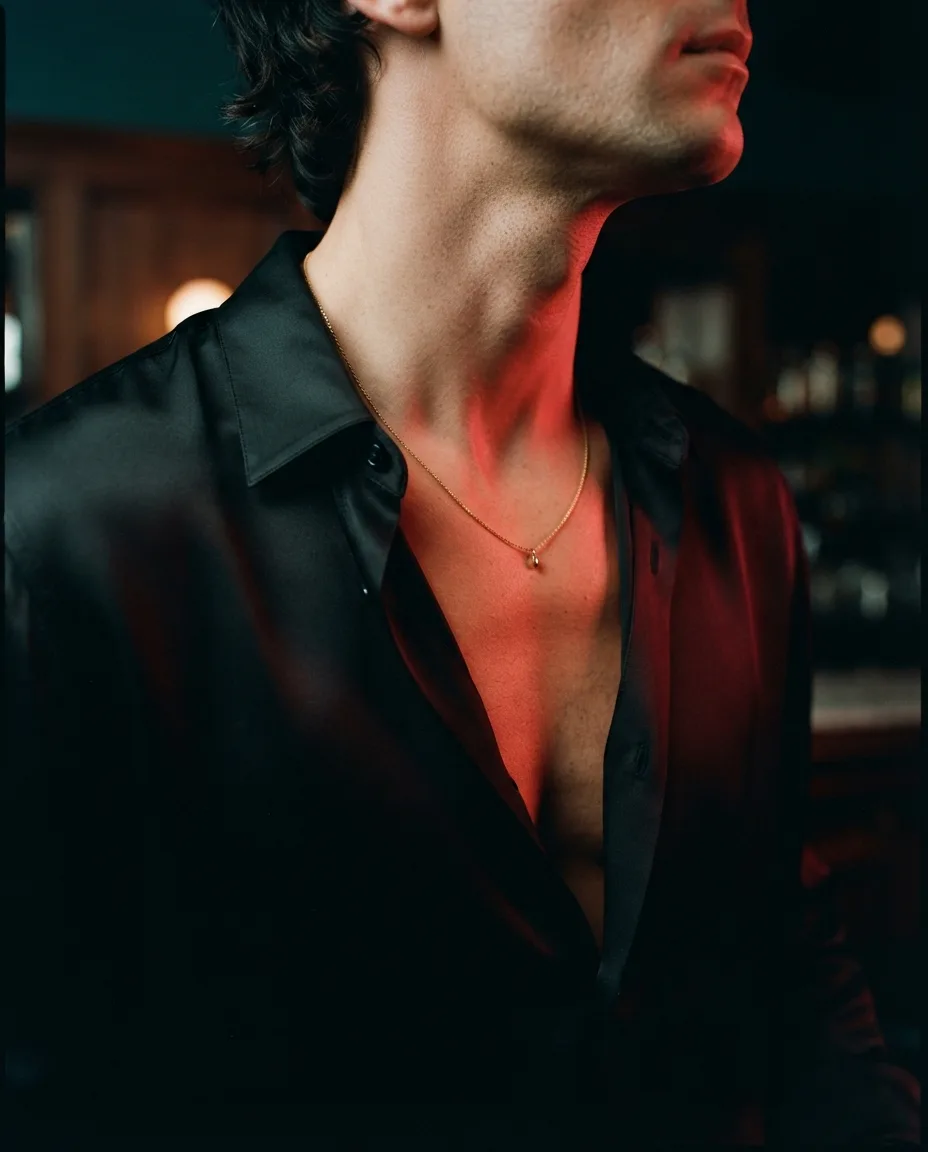
Every style guide on earth judges an outfit by how it looks going on. The mirror, the walk to the door, the first impression across a bar. Fair enough. But the clothes you pick for a date night have a second job that nobody writes about, and it happens later, in worse lighting, with someone else’s hands involved.
That second job is coming off. A shirt with stubborn buttons, a belt that needs a two-handed wrestle, a pair of socks that outstays everything else: none of these ruin an evening, but they do add a few beats of comedy you didn’t schedule. This is a guide to the outfit judged from the other direction, top to bottom, with the fabric facts where they matter and plain opinion where they don’t.
None of it requires new money. Most of it is about choosing between things you already own.
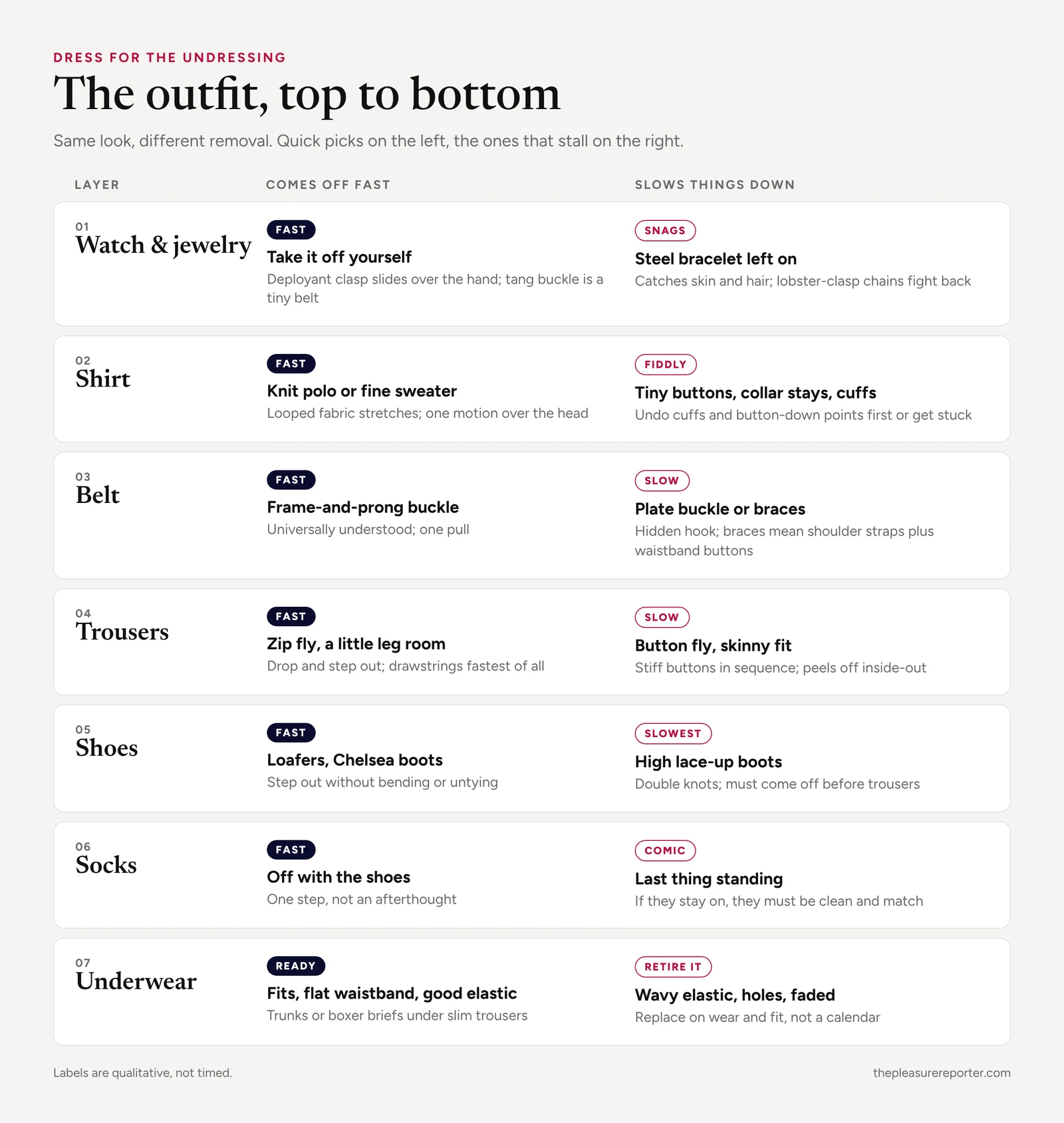
The short version: Pick a shirt with normal-sized buttons and a soft collar, or skip buttons with a knit. Wear a frame-and-prong belt or no belt at all. Zip fly over button fly when speed counts. Shoes you can step out of, socks that go when the shoes go. Underwear that fits, has working elastic and isn’t a decade old. Take the watch off before anyone else has to.
The shirt: buttons, plackets and the case for knits
Start with the buttons, because they are where most of the fumbling happens. Buttons are sized in lignes, an old trade unit where 40 lignes make an inch, so one ligne is about 0.635 mm. A typical quality dress-shirt button sits around 11 mm across; Kent Wang, for one, lists its mother-of-pearl shirt buttons at 11 mm wide and 3.5 mm thick. That’s a sensible size. Trouble starts at either extreme: tiny decorative buttons on fashion shirts that slip between fingertips, or thick, chunky ones forced through buttonholes cut a touch too tight.
Do a quick test at home. Undo your shirt with one hand, starting from the top, without looking down. If it’s a smooth run, that shirt is date-ready. If the third button needs a second attempt and some muttering, that shirt is for meetings.
The placket matters too. A standard front placket is the folded strip of fabric that holds the buttonholes; it gives the holes a firm edge and helps them behave. A French front skips the strip for a cleaner look, which can leave buttonholes a little softer and less predictable.
Then there are the small hardware traps. Button-down collars have two extra buttons at the collar points that get forgotten until the shirt is halfway over someone’s head and stuck. Cuff buttons are the same story: undo them before the main event, or the shirt ends up as a pair of fabric handcuffs. Western shirts with snaps are the exception that proves the rule. One firm pull, top to bottom, and you’ve made an entrance in reverse.
Collar stays: take them out early
Collar stays are thin, rigid strips slipped into pockets under the collar points to keep them crisp. They come in plastic, brass, steel, horn and even sterling silver. They also tend to fall out at exactly the wrong moment and turn up later in the sheets. The standard advice is to remove them before laundering or ironing anyway, since pressing over a stay can leave an imprint in the collar. So you lose nothing by pocketing them on the way out of the bathroom. A shirt with a soft, unstayed collar, or a button-down where the buttons do the stay’s job, skips the problem entirely.
Knit versus woven
Here’s the fabric fact that changes the whole shirt question. Woven fabrics like poplin, oxford cloth and denim are made by crossing two sets of yarn at right angles on a loom, which makes them firm, shape-holding and not very stretchy. Knits like jersey and rib are made from interlocking loops, and those loops let the fabric stretch in both directions.
That’s why a knit polo, a henley or a fine merino sweater comes off in one motion over the head while a woven dress shirt has to be unbuttoned in the right order. If the evening is relaxed, a knit is quietly the most cooperative thing in your wardrobe. A two-button polo or a crew-neck in fine wool looks deliberate, not lazy, and it removes the button question altogether.
A knit is quietly the most cooperative thing in your wardrobe.
Merino has a second argument going for it. Textile scientist Rachel McQueen, now at the University of Alberta, had men wear test T-shirts in polyester, cotton and merino for two days, then had odor rated on the underarm fabric. Polyester came out the smelliest and merino the least. Interestingly, the bacteria survived longest in the merino, so the result wasn’t about wool killing germs. The likely explanation is that wool absorbs and holds odor molecules better. For a night that runs long, that’s useful to know.
Belts, buckles and the braces question
A belt is the first piece of hardware anyone else’s hands will meet, so pick one that opens the way people expect. The classic frame-and-prong buckle is the oldest design and still the most intuitive: a frame, a prong that goes through a hole, the loose end tucked into a keeper. Everybody alive has unbuckled one. It gives way with one pull.
Plate buckles are a different animal. On many modern Western-style plates, the big decorative plate stays on the outside and a hook on the back goes into the belt hole, pointing toward the wearer. The front looks great. The mechanism is hidden. And a hidden mechanism means a partner pulling at a slab of metal that doesn’t move while you try to help from the wrong angle. Save the rodeo buckle for nights that involve an actual rodeo.
Ratchet belts, the kind with a track on the back and a release lever on the buckle, have the same issue in miniature. Fast if you know where the lever is. A puzzle if you don’t.
Braces deserve a mention, mostly as a warning. Proper braces button onto the trousers, and the tailoring rule is firm on one point: never wear a belt with them. They look sharp with a suit, and they hold trousers up beautifully. But taking them off means sliding straps off the shoulders and then working through a row of waistband buttons, some of them at the back. Clip-on versions are quicker but less elegant. If you love them, wear them, and accept that you’ll be doing the honors yourself.
The quietest choice of all is trousers that don’t need a belt. Side adjusters, the small tabs with buckles at the hip seams, or a well-fitted waistband do the job with nothing on the front to wrestle.
Trousers: the fly is a style decision
Button flies and zip flies had a real fight once. According to histories of the zipper, the zip won what was dubbed the “Battle of the Fly” in 1937, after French designers took it up for men’s trousers. A Talon ad in Esquire even pitched the zippered fly as protection against embarrassing disarray. Disarray, of course, is sometimes the point.
For speed, the zip wins. One pull. Button flies on denim look honest and wear well, but four or five stiff metal buttons through heavy cotton is a slow, sequential task. Fine alone; less fine when someone else is helping and the denim is new.
Fit matters as much as the fly. Trousers so slim they have to be peeled off inside-out, with the cuff catching on your heel, cost more time than any fastening. A little ease through the thigh and an opening wide enough to clear the foot means trousers drop and step off. With skinny jeans, the shoes have to come off first.
Drawstring and elastic-waist trousers are the cheat code: linen drawstrings in summer, a soft knit trouser on a night in. Nothing comes off faster.
Shoes and the socks problem
Order of operations matters here. Everything below the waist depends on the shoes coming off first, because few trousers clear a pair of brogues. So the ideal date-night shoe is one you can step out of without bending down or untying anything.
Loafers win this category outright. Chelsea boots with elastic sides come next: a tug at the heel tab and they’re gone. Laced shoes are slower, especially with double knots, and high lace-up boots are the slowest thing in the whole outfit. If you’re going to wear lace-ups, loosen them a touch before you sit down and you’ll be able to slip them off heel-first.
Then the socks. A man standing in nothing but his socks is one of the most reliable comic images ever invented, and you don’t need to provide it. The fix is simple: take the socks off when the shoes come off, as one step, not as an afterthought at the end. Thin dress socks peel off easily. Over-the-calf socks, which stay up beautifully all evening, take a second longer, which is worth it if your shins aren’t your best feature.
There is a counterargument, and it’s a fun one. In 2005, University of Groningen researcher Gert Holstege presented early brain-scan research on orgasm at a European fertility conference. Participants in the scanner complained of cold feet, so they were given socks, and the widely reported result was that more couples reached orgasm with socks on. It was a small lab study, the sock detail was incidental to the research question and it hasn’t been properly replicated. Still, if your feet run cold, warm socks in bed aren’t a crime. Just make sure they’re clean, matching and free of holes. Socks that stay on have to pass inspection.
Underwear is a style decision
This is where most men put the least thought and where the payoff is biggest. Outer clothes get seen by the whole room. Underwear gets seen by one person, at a moment when they are paying very close attention.
The basic styles, from least to most fabric:
- Briefs: no leg, full support, a classic shape that looks best on men who are comfortable with it.
- Trunks: a short leg, a lower rise and close fit. The modern default and hard to get wrong.
- Boxer briefs: a longer leg that stays put under trousers, with the support of a brief.
- Boxers: loose, woven or knit, with no support and plenty of airflow. They bunch under slim trousers.
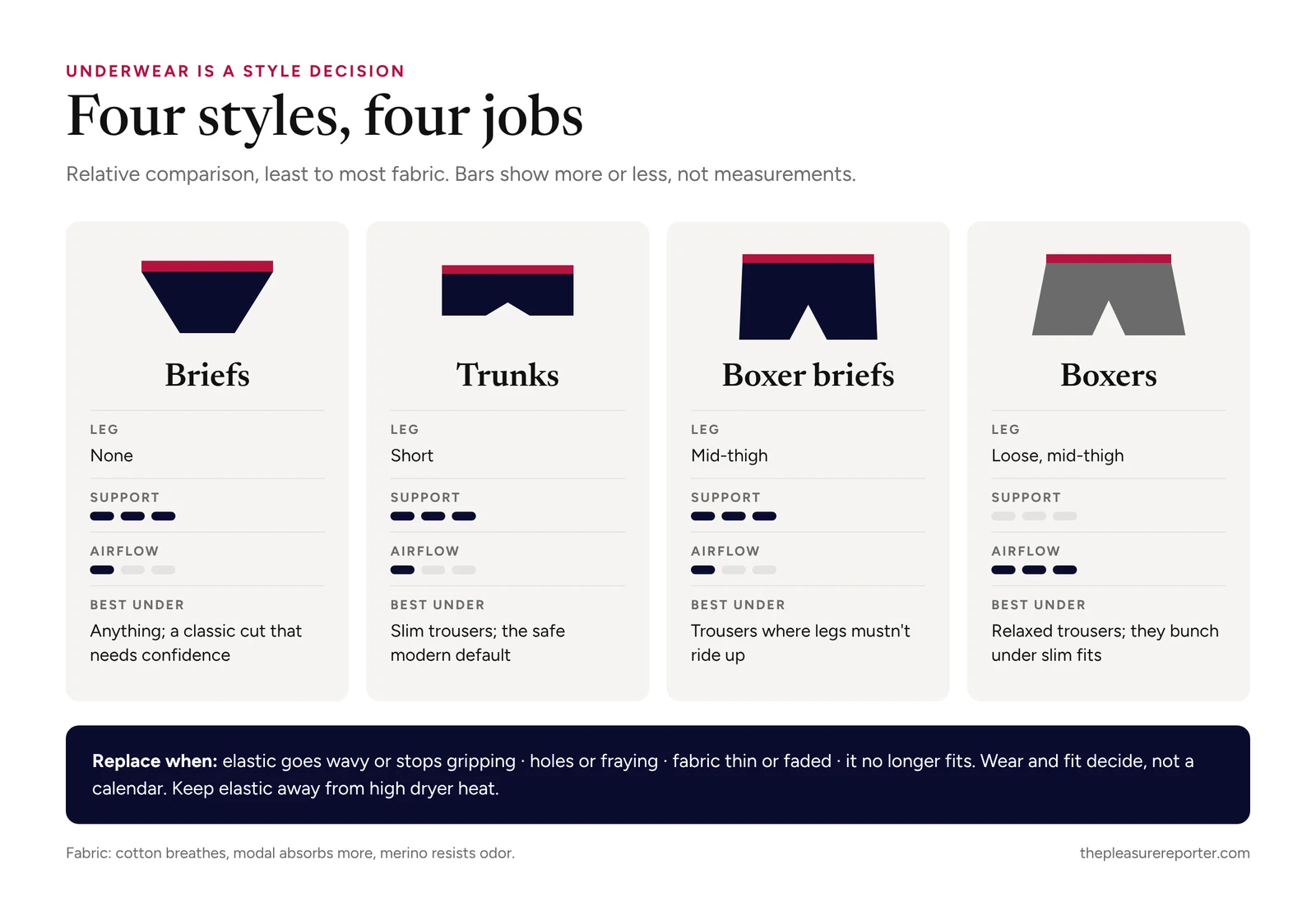
Fit is the whole game. Underwear that’s too tight digs in at the leg and waistband and leaves marks that are visible later. Too loose and it sags in a way that looks tired. The waistband should lie flat without rolling, the leg should sit without riding up and the pouch, if there is one, should support without squeezing.
Fabric
Cotton is the reliable choice: breathable, washable, familiar. Modal, a fiber made from beech-tree cellulose, feels smoother and silkier and is around 50% more water-absorbent than cotton by volume, which is why it shows up in so many premium pairs. Merino underwear brings the same odor resistance as merino tops. Synthetic blends of polyester or nylon with elastane are built for the gym and hold their shape, but polyester was the smelliest fabric in that McQueen T-shirt study. Gym underwear is for the gym.
Temperature has a health angle worth knowing without overstating. A 2018 Harvard study in Human Reproduction of 656 men at a fertility clinic found those who mostly wore boxers had 25% higher sperm concentration and 17% higher total sperm count than men in tighter styles. That’s an association, not proof, and in a fertility-clinic population. A 2026 review in Translational Andrology and Urology found tight underwear can raise scrotal temperature by about 1°C, but that the evidence on actual fertility outcomes is inconsistent. Its conclusion: underwear is a supportive lifestyle factor, not a fertility treatment. If you’re trying to conceive and concerned about it, that’s a conversation for your doctor, not your dresser.
When to replace
Ignore the viral rules about throwing out your underwear every six or nine months. Doctors quoted pushing back on that claim, including Canadian gynecologist Jennifer Gunter, said regular washing handles hygiene and the real reasons to replace a pair are wear and fit. That means:
- the elastic has gone wavy or no longer grips;
- there are holes, fraying or a waistband coming away from the body;
- the fabric has gone thin, pilled or faded to an uncertain gray;
- it no longer fits, in either direction.
Look after elastic and it lasts longer. Heat makes elastane brittle, according to RMIT textile researcher Carolina Quintero Rodriguez, so a low dryer setting or a drying rack keeps waistbands working. And keep a couple of pairs in reserve that are only for nights you expect to be seen. Retire them to everyday duty when the next good pair arrives.

The watch, the jewelry and the scent
A watch is the only thing in the outfit that can actually scratch someone. Steel bracelets catch skin and hair; a big case knocks against a headboard. Take it off yourself and put it somewhere safe, which is also a quietly confident move. It says you’re not in a hurry to be anywhere else.
Clasp type makes this easier or harder. A tang buckle works like a tiny belt: pin out of hole, strap out of keeper. A deployant clasp on a strap keeps both ends attached and lets you slide the watch over your hand, which is quicker once you know the trick and, as a bonus, puts less wear on the strap.
Rings and chains follow the same logic. A chain with a fiddly lobster clasp is better left on than battled with. Chunky rings come off. Cufflinks go into a pocket with the collar stays, not onto a nightstand where they’ll roll under the bed for a month.
Scent is the last layer and the only one that stays on. Where you put it matters more once the shirt comes off: chest, neck and the inside of the wrists are close enough to be found and not so heavy that they announce you from the doorway. We cover placement, and why you should own more than one, in our three-fragrance scent strategy.
Putting it together
None of this asks you to dress for speed at the cost of looking good. The point is to remove the friction points so the second half of the evening runs as smoothly as the first. A good shirt, a simple belt, trousers that fit, shoes you can step out of and underwear you’d be happy to have seen covers it.
And don’t forget that taking your time is allowed. Undressing someone slowly is part of the fun, and a shirt with a dozen easy buttons gives a partner something to do with their hands. The goal is control: quick when you want quick, slow when you choose slow, never stuck because a buckle had other plans. If slow is where your head’s at, our guide to taking twice as long picks up where this one ends.

Traveling? The same rules apply in a hotel room, only with less storage and worse lighting. Our notes on making a hotel room work and packing the discreet kit cover the rest, and when it’s over, there’s the morning after, which is also a wardrobe problem.
Quick answers
Should I take my own clothes off or let my partner do it?
Both, depending on the piece. Let them have the shirt and anything with a visible fastening. Handle the hidden mechanisms yourself: braces buttons, plate buckles, watch clasps and collar stays. That split keeps it playful without anyone getting stuck.
Are boxers or briefs better for a date?
Neither by default. Trunks or boxer briefs are the safest all-round choice because they lie flat under slim trousers and still look tidy once the trousers are gone. Loose boxers under skinny jeans tend to bunch, which shows on the way out.
What about undershirts?
A fitted crew-neck or V-neck undershirt protects a good shirt from sweat, but it adds a layer and a second over-the-head step. On a warm night, or with a dark or patterned shirt where sweat shows less, skip it.
How do I stop collar stays from getting lost?
Take them out in the bathroom or the cab and put them in a fixed pocket, the same one every time. Metal stays are worth the small upgrade: plastic ones bend over time and need replacing, and a bent stay is the one most likely to work itself loose.
Is it rude to leave my watch on?
Not rude, just risky. A metal bracelet can pinch skin or pull hair, and a bezel can scratch. If you prefer to wear it, a soft fabric or rubber strap is far kinder than steel links.