How to Bring a Toy Into Bed Without Making It Weird
The conversation, the timing and the one thing never to say. A field guide for the first time a device joins the two of you.

Somewhere in your sock drawer, or still in a browser tab, is a small silicone object you would like to introduce to the person you sleep with. The object is not the hard part. The hard part is the thirty seconds where you say so out loud, and the faint dread that those thirty seconds will be heard as a review of everything that came before.
That dread is understandable and mostly misplaced. Toys in shared beds are ordinary, the research on couples who try one is encouraging, and the ways this goes wrong are predictable enough to avoid. What follows covers the conversation (when, where and in what words), how to choose the first one together, how to run the first session so nobody feels like a test subject, what to do if it lands with a thud, and the one sentence that turns a fun idea into a small domestic incident.
The short version: Bring it up clothed, calm and nowhere near the bedroom. Frame it as something you want to try together, not something that is missing. Choose the toy as a pair, start on the lowest setting, and let your partner hold the controls. Never present it as a fix for them. If they say no, the no stands, and the conversation still counts.
The numbers say this is normal
Start with the reassurance; you will pitch better if you are not quietly panicking. In 2009, researchers at Indiana University ran nationally representative surveys of Americans aged 18 to 60 and found that 52.5% of women and 44.8% of men had used a vibrator. Among the men who had, 91% said it had been during foreplay or intercourse with a partner. The researchers found vibrator use was linked to better scores on standard measures of sexual function for both sexes. Linked, not caused: these were surveys, and the work was funded by the company behind Trojan condoms, which is worth knowing even if it does not change the arithmetic.
A later paper from the same data set asked about beliefs. About 37% of women agreed that vibrators are intimidating to their partners. Roughly 70% of men disagreed. So the fear that a toy will wound a man’s pride is held more firmly by the people worried about wounding it than by the men themselves. A related analysis of women’s partnered use found that, for heterosexual women, a partner knowing about the vibrator and being seen to like it significantly predicted her sexual satisfaction. Your attitude toward the thing is part of what makes it work.
The couples studies are smaller but point the same way. In a University of Guelph study, 49 men in committed relationships were given a wearable couples’ vibrator for two months; 71% said it enhanced their pleasure and 88% planned to keep using it. A companion study of 49 heterosexual couples found that 75.5% of men and 79.5% of women described their sexual relationship as improved after six to eight weeks of prescribed sex with and without a toy. In fairness to the evidence, the standardized questionnaires in that study showed no statistically significant change. The couples said it helped; the scales did not move. Treat the toy as a promising addition, not a proven upgrade.

When and where to bring it up
Not in bed. Not mid-act, with the thing already in your hand like a waiter presenting the specials. Not the morning after a night that did not go well, and not by text from the office in a burst of courage you will regret by lunch. Each turns an invitation into an ambush or a post-mortem.
Pick a neutral moment when you are both clothed, fed, unhurried and in a decent mood. A walk works: you can talk without having to hold eye contact through the awkward bits. So does the couch on a slow evening, or the drive home from somewhere you both enjoyed. The point is low stakes: nobody has to decide anything tonight, and nobody is being asked to perform.
The opening matters more than you think. Relationship researcher John Gottman’s lab found that how a conflict discussion starts predicts how it ends; the Gottman Institute says the outcome can be predicted 96% of the time from the first three minutes. His work is about arguments, not sex toys, so take this by analogy. But the advice that follows from it, which Gottman calls a “softened startup,” fits this conversation well: describe rather than judge, talk about what you feel and want, skip the blame, be warm, and do not save the topic up until it bursts out sideways.
Raise it early in the week rather than on the night you hope to use it. That gives your partner time to come back with an opinion rather than a reflex.
How to phrase it so it sounds like an invitation
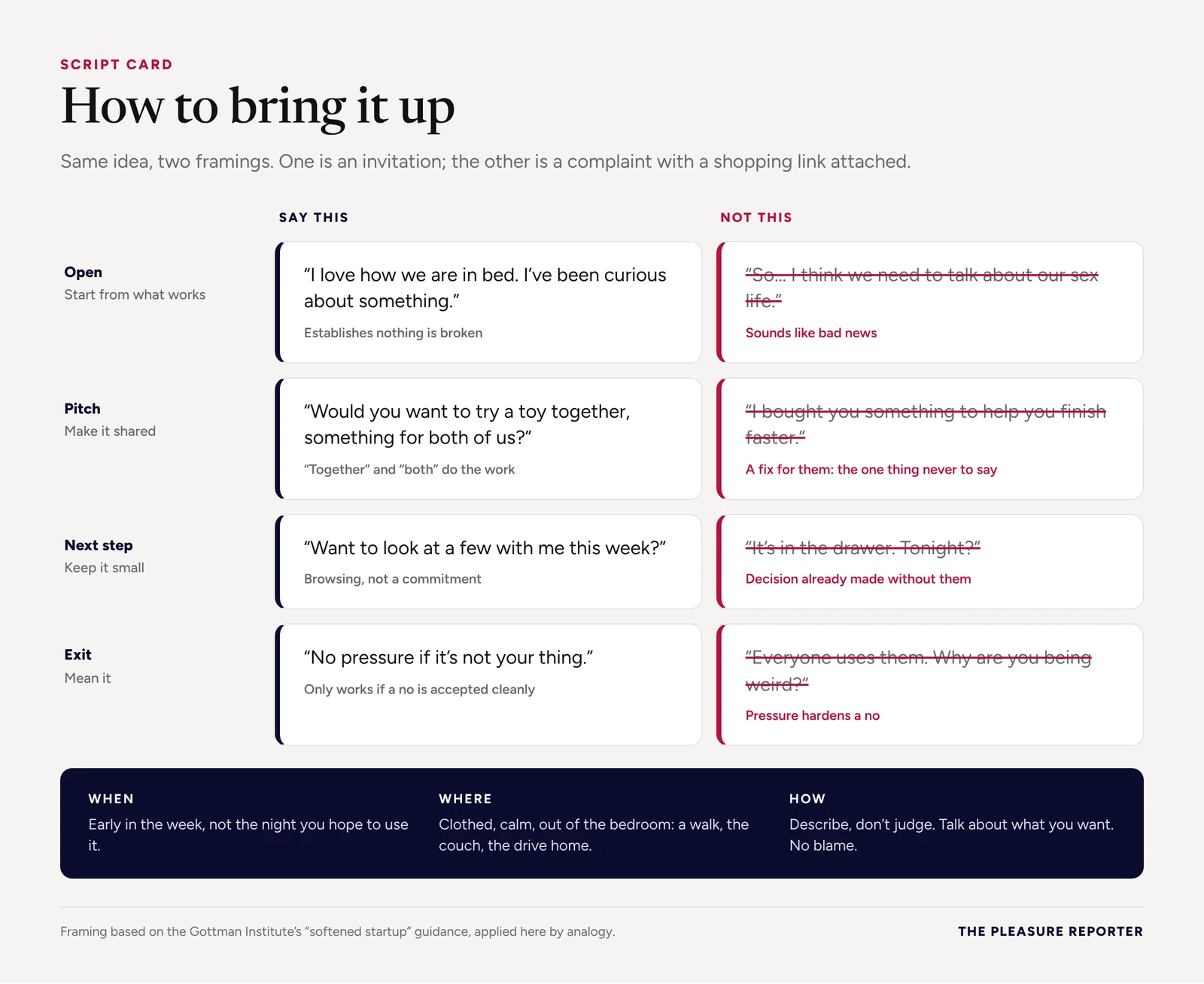
The structure is simple. Lead with something true and good about your sex life, say what you are curious about, make it about the two of you, and leave the door genuinely open. Something like: “I love how we are in bed. I have been curious about trying a toy together, something for both of us. Would you be up for looking at a few with me? No pressure if it is not your thing.”
Every clause there is doing a job. The compliment establishes that nothing is broken. “Curious” signals novelty rather than need. “Together” and “for both of us” make it shared. “Looking at a few with me” turns the next step into browsing, not a commitment. And “no pressure” only works if you mean it, which you will need to, because they will be listening for whether you do.
Bring curiosity about what they might want, too; ask whether there is anything they have wondered about trying. Let them ask questions without treating each one as resistance. If they laugh, laugh with them. The idea of a small humming gadget joining two grown adults in bed is a bit funny, and pretending otherwise makes it weirder.
The toy is not a referendum on the last five years. Say so, and then act like it.
The one thing never to say
Never frame the toy as a fix for your partner. Not “it might help you finally finish,” not “since you take so long,” not “this way it is less work for me,” and not the gentler but equally lethal “I just think you need a bit more help.” Each of those converts a shared adventure into a diagnosis. Your partner hears that they have a problem, that you have noticed, that you have been thinking about it for a while, and that you went shopping for a solution without them.
This is a real temptation for well-meaning men, because the orgasm gap is real. In a survey of more than 52,000 US adults published in Archives of Sexual Behavior, 95% of heterosexual men said they usually or always orgasm during sex, against 65% of heterosexual women. A vibrator can close part of that gap; the same study linked women’s orgasm frequency to more varied genital stimulation, longer sex and asking for what they want. But the gap is a pattern across couples, not a flaw in your partner, and naming it as their shortcoming will not make anyone more relaxed in bed.
The fix framing also has a mirror image that is just as bad: presenting the toy as a confession about yourself, as in “I am clearly not enough.” It sounds humble. It actually hands your partner a job, which is reassuring you, at the exact moment you wanted them thinking about fun. Keep the frame on curiosity and play. “I want to try this with you” is the whole message.
Choosing the first toy together
Shop as a pair. Sit with a laptop, browse a few reputable retailers, and let the person who will feel most of it have the deciding vote. Choosing together does two things: it gets you a better toy, and it makes the toy partly theirs before it ever arrives, which is a different emotional object from something you produced from a drawer.
For a first purchase, keep it small, simple and quiet enough to forget about. Body-safe silicone is the default material, and water-based lube is the safe partner for it; silicone lube can degrade silicone toys over time. Our guide to lubes covers the rest. Then match the type to what you two actually want, rather than to what looks impressive on a product page.
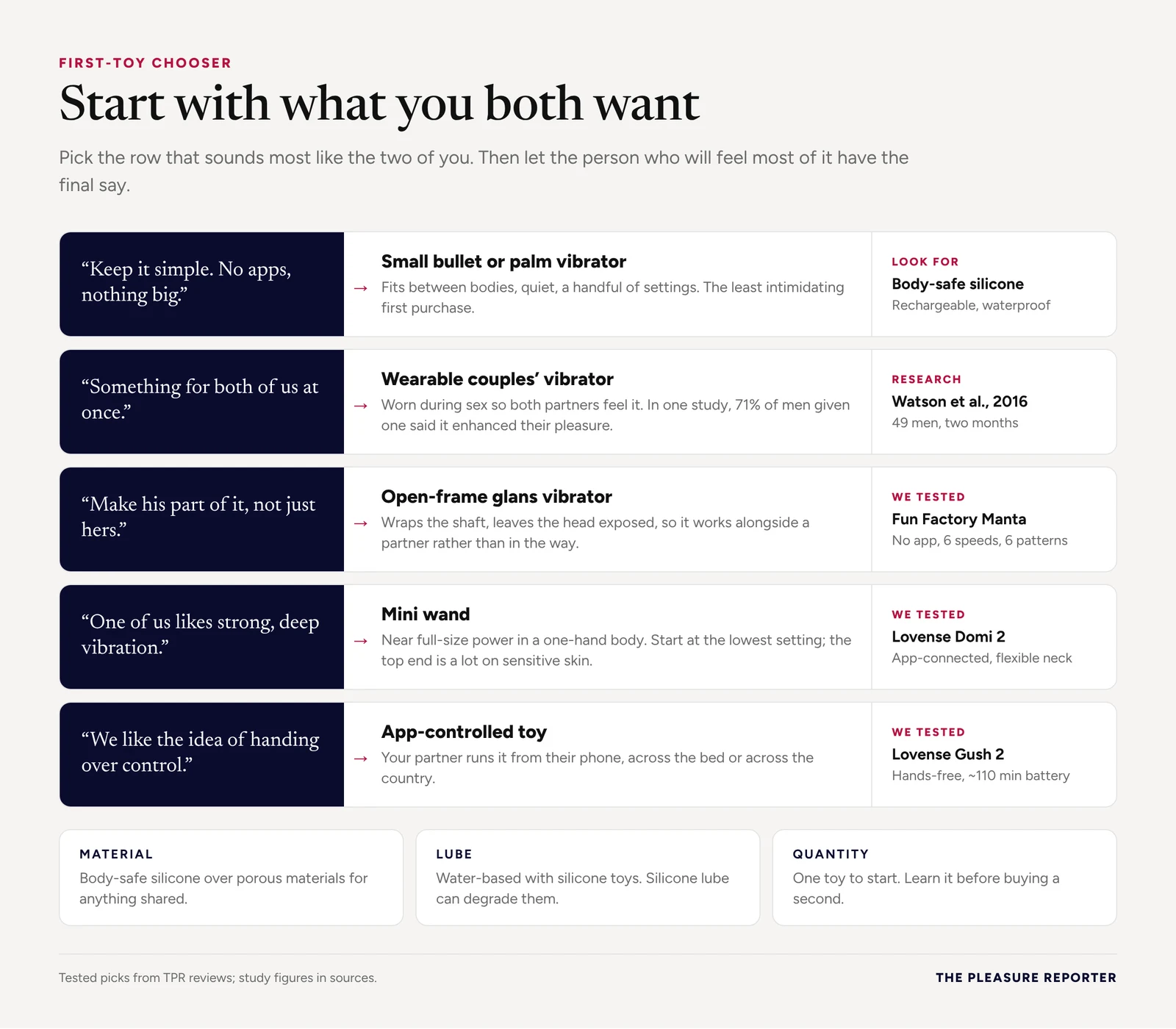
Three tested options are worth a specific mention. The Fun Factory Manta is a wing-shaped silicone frame he wears around the shaft with the head left exposed, and it is the toy we kept reaching for during partnered play across six months of testing; in our Manta review we described it as working with a partner rather than instead of one. It has no app, six speeds, six patterns and illuminated buttons you can find in the dark, which suits a nervous first night.
The Lovense Domi 2 is a compact wand with close to full-size power, which makes it a good shared toy for the partner who likes strong, rumbly vibration and a careful one for anyone else. Our Domi 2 review is blunt that the top settings can be too much on sensitive skin, so start at the bottom. If you are torn between deep rumble and focused buzz, our Domi 2 vs Manta head-to-head lays out the difference.
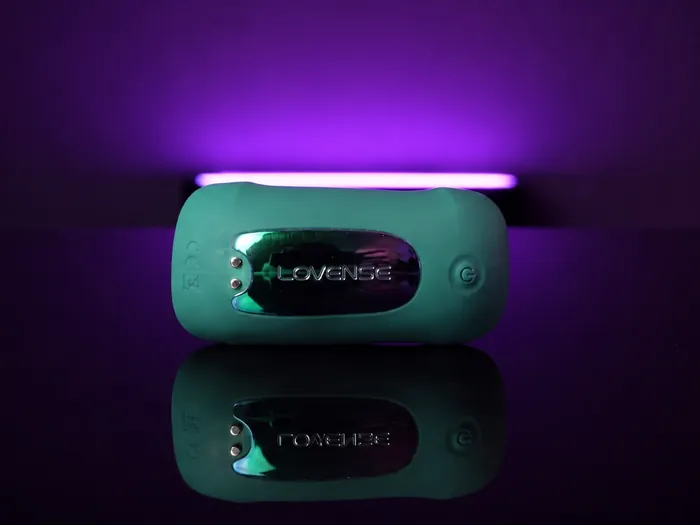
The Lovense Gush 2 is a hands-free glans vibrator for him, controlled through the Lovense Remote app, which lets a partner take over the controls from across the bed or across the country. Handing someone the remote for your toy is a surprisingly good opener, because it gives them the power and you the vulnerability. Our Gush 2 review notes a battery of about 110 minutes, which is more than enough for a first go. If distance is part of your story, see our guide to app toys for long-distance couples.
The first session
Charge it the day before and wash it before first use. A dead battery is a mood killer; so is reading the quick-start leaflet aloud in your underwear. Put the lube within reach and the toy somewhere visible rather than hidden, so its arrival is not a magic trick.
Introduce it partway in, not at the start and not as the grand finale. Starting with it makes the evening about the gadget. Saving it for the end makes it feel like a rescue. Somewhere in the middle, when you are both relaxed, is where it reads as play.
Start on the lowest setting and let your partner hold it or control it, at least the first time. Use it on the outside of the body before anywhere more sensitive, and check in with short, specific questions (“lighter or firmer?”) rather than the anxious “is this okay?” every forty seconds. The toy is a guest, not a replacement for the host.
Expect a little comedy. Motors hum, silicone squeaks, and somebody will drop it. Laugh. Couples in the Guelph study listed novelty and fun among the main ways a toy improved things, and a toy that never got a laugh probably never got relaxed into either. If it is not working tonight, switch it off and carry on without it. That is not failure. That is a normal Tuesday with an extra object on the nightstand.

If it lands badly
Sometimes the answer is no, or a polite “maybe” that means no, or a pause that goes on a beat too long. Sometimes it is a yes that turns into a flat first session. None of these is a disaster, and how you respond decides whether the topic stays open.
If the answer is no, accept it in the moment, cleanly, without a sigh or a sales pitch. “Fair enough, thanks for hearing me out” is the whole reply. Later, if it feels right, you can ask what made it feel off: worry about what it implies, embarrassment, a bad previous experience, a sense it might replace you or them. Each needs a different answer, and only listening tells you which you have. Then leave it alone. A gracious no often softens into a curious maybe weeks later. A pressured no tends to harden.
If the first session flopped, debrief lightly the next day, out of bed, with the same tone you would use for a restaurant that did not live up to its reviews: what was good, what was weird, try again or try something else. If the toy is wrong, try a different type.
If the conversation surfaces something bigger, such as resentment, a long-running mismatch in desire, or pain during sex, the toy was never the real subject. A certified sex therapist is the right next call for the relationship side. For pain, numbness that does not fade, or any change in sensation that lingers after a session, see a doctor.
Quick answers
Is it better to buy the toy first as a surprise?
Generally no. A surprise purchase skips the part where your partner gets a say, and it can read as a decision already made. If you have already bought one, say so plainly during the conversation and make clear it can go back in the drawer, or be swapped for something they would rather try.
What if my partner already owns a vibrator they use alone?
That is a head start, not a threat. Ask whether they would like to bring it in, and let them show you how they use it. In the Indiana University data, partnered satisfaction was tied to the partner knowing about the vibrator and liking it, so your interest is part of what makes it work.
Does this advice apply to same-sex couples?
The conversation advice applies to anyone. Most of the couples research cited here studied heterosexual couples, though a separate study of more than 2,000 women who have sex with women found that those who used vibrators with a partner reported more sexual satisfaction than those who used them only alone or never.
How do we clean a shared toy?
Wash it before and after every use with warm water and mild, unscented soap, then let it dry fully before storing. Check whether it is waterproof before rinsing; the Domi 2, for example, is splash-resistant but not submersible. If the toy moves from one body to the other during a session, give it a wash before it does.
How many toys should we start with?
One. A drawer full of options turns the first night into a product demo. Learn one toy well, see what you both like about it, and let that shape the second purchase.