Stamina Is Mostly Sleep, Breath and Pelvic Floor
The unglamorous training plan that actually moves the needle, minus the supplement aisle.

The supplement aisle sells stamina in a jar. It comes in a black bottle with a gold lid, a name that sounds like a monster truck, and a label promising results “naturally.” The actual stamina program costs nothing and has no packaging at all. It looks like going to bed earlier, walking faster, breathing slower and squeezing a muscle you have probably never thought about while waiting for the kettle.
Less exciting, yes, but there is research behind it. Not a mountain of perfect research, and we will flag where the studies are small. Still, sleep, cardiovascular fitness and pelvic floor training each have trials or large studies connecting them to erections and ejaculatory control. Most over-the-counter “male enhancement” products have nothing of the kind, and some have been caught hiding prescription drugs.
The short version: Sleep at least seven hours, because one week of five-hour nights cut daytime testosterone 10–15% in young men. Do regular moderate-to-vigorous cardio, which improved erectile function scores in meta-analyses of trials. Train your pelvic floor for 12 weeks, which helped men with ED and premature ejaculation in small studies. Use slow breathing to take the edge off arousal, but know that part is less proven. Skip the “enhancement” pills. And if erections are failing in your 40s, book a heart check, not just a prescription.
Sleep is the first workout
In 2011, researchers at the University of Chicago published a short paper in JAMA that every man who brags about running on five hours should read. Ten healthy men, average age 24, spent a week sleeping normally at home, then moved into a sleep lab. After three nights of 10-hour bedtimes, they were held to five hours a night for eight nights. Their daytime testosterone dropped by 10% to 15%, with the dip most obvious in the afternoon and evening.
For scale, the authors noted that normal aging lowers testosterone by about 1% to 2% a year. On paper, a single week of short nights did somewhere between five and 15 years’ worth of that. The study was tiny and measured hormones, not performance. Treat it as a strong hint that the tired, flat version of you is partly a chemistry problem.
The CDC recommends seven or more hours a night for adults aged 18 to 60. The usual fixes are boring on purpose: a consistent wake-up time, a dark and cool room, fewer late screens. And if the reason you were up late was a good one, our guide to the morning after done right covers how to make the next day less of a write-off.
The snoring problem nobody wants to hear about
In obstructive sleep apnea, your airway keeps collapsing during sleep, so breathing stops and starts all night. It is also linked to erectile dysfunction. A 2015 meta-analysis in the Journal of Sexual Medicine pooled observational studies and found men with sleep apnea had about 1.8 times the risk of ED. A larger 2018 review of 28 studies pointed the same way. These are associations, not proof that apnea causes ED, but they are consistent enough to take seriously.
The NHS lists the warning signs: loud snoring, gasping, snorting or choking noises in your sleep, breathing that stops and starts, waking up a lot, and feeling exhausted during the day despite a full night in bed. If a partner has already mentioned it, that is a doctor’s appointment, not a joke.

Your erections run on plumbing
An erection is a blood-flow event, which means the health of your blood vessels is the health of your erections. The Mayo Clinic researchers below put it this way: ED and heart disease may be different faces of the same underlying vascular problem.
The clearest data comes from a Mayo Clinic study published in 2009. Researchers followed 1,402 men without known heart disease for up to a decade. Among men in their 40s, those without ED developed coronary artery disease at a rate of about one case per 1,000 person-years. Those with ED developed it at about 49 per 1,000 person-years. In men over 70, ED added little predictive value. The authors’ conclusion was blunt: a younger man with ED is a good candidate for heart-risk screening.
A younger man with failing erections should get his heart checked before he gets a prescription.
The flip side is encouraging. A 2017 meta-analysis in the British Journal of Sports Medicine pooled seven randomized trials with 478 men who had ED. Exercise programs improved erectile function scores by an average of 3.85 points, with moderate-to-vigorous aerobic exercise looking most useful. A 2023 meta-analysis of 11 trials in the Journal of Sexual Medicine found a smaller average gain of 2.8 points on the 6-to-30 erectile function scale, but nearly 5 points in men with severe ED. A 2011 Mayo Clinic meta-analysis found that lifestyle changes aimed at heart risk factors improved scores as well.
Those are real but moderate effects. Cardio will not turn a 60-year-old smoker into a 22-year-old, but it works on the same pipes the problem lives in. Aim for moderate-to-vigorous aerobic work: brisk walking that leaves you a little breathless, cycling, swimming, running. Pick whatever you will actually keep doing.
Meet the muscles you have been ignoring
The pelvic floor is a sling of muscle between your tailbone and pubic bone. In men, two of its members matter most for sex. The bulbospongiosus wraps the base of the penis, and the ischiocavernosus runs along each side. They help keep blood in an erection, and during ejaculation they contract rhythmically to push semen out. A 2015 review of male sexual physiology in Fertility and Sterility lays out that role. The theory follows: weak muscles, softer erections and less control. Here is what testing has shown.
For erections: the Dorey trial
Physiotherapist Grace Dorey ran a randomized trial in the UK with 55 men who had had ED for at least six months; their median age was 59. Twenty-eight were taught pelvic floor exercises by a physiotherapist and given biofeedback and lifestyle advice. The other 27 got lifestyle advice only. At three months, the exercise group’s erectile function scores were about 6.7 points higher than controls.
After six months, a blinded assessor rated 40% of the men as having regained normal erectile function. Roughly another third had improved, and about a quarter did not improve. Results appeared in the British Journal of General Practice (2004) and BJU International (2005). Note that this was one clinic, with a physio teaching technique in person. Random squeezes in traffic are not the same intervention.
For premature ejaculation: promising, not proven
In 2014, an Italian team led by Antonio Pastore treated 40 men with lifelong premature ejaculation, all lasting a minute or less, with a 12-week pelvic floor rehabilitation program. By the end, 33 of them (82.5%) had gained control of the reflex, with an average time to ejaculation of about 146 seconds, roughly two and a half minutes. Of the 13 men checked again at six months, the gains largely held.
Those numbers look great, and the study has real limits. It had no control group, the program was supervised in a clinic, and only a third of the improved men were followed up. A 2019 systematic review of ten trials in Physiotherapy concluded that pelvic floor training appears to help both ED and premature ejaculation, but rated the studies low to moderate in quality and said no ideal training protocol has been identified. So: worth doing, cheap to try, not a guarantee. If speed is the issue, pairing it with the pacing ideas in slow sex: take twice as long makes sense.
How to find and train them, step by step
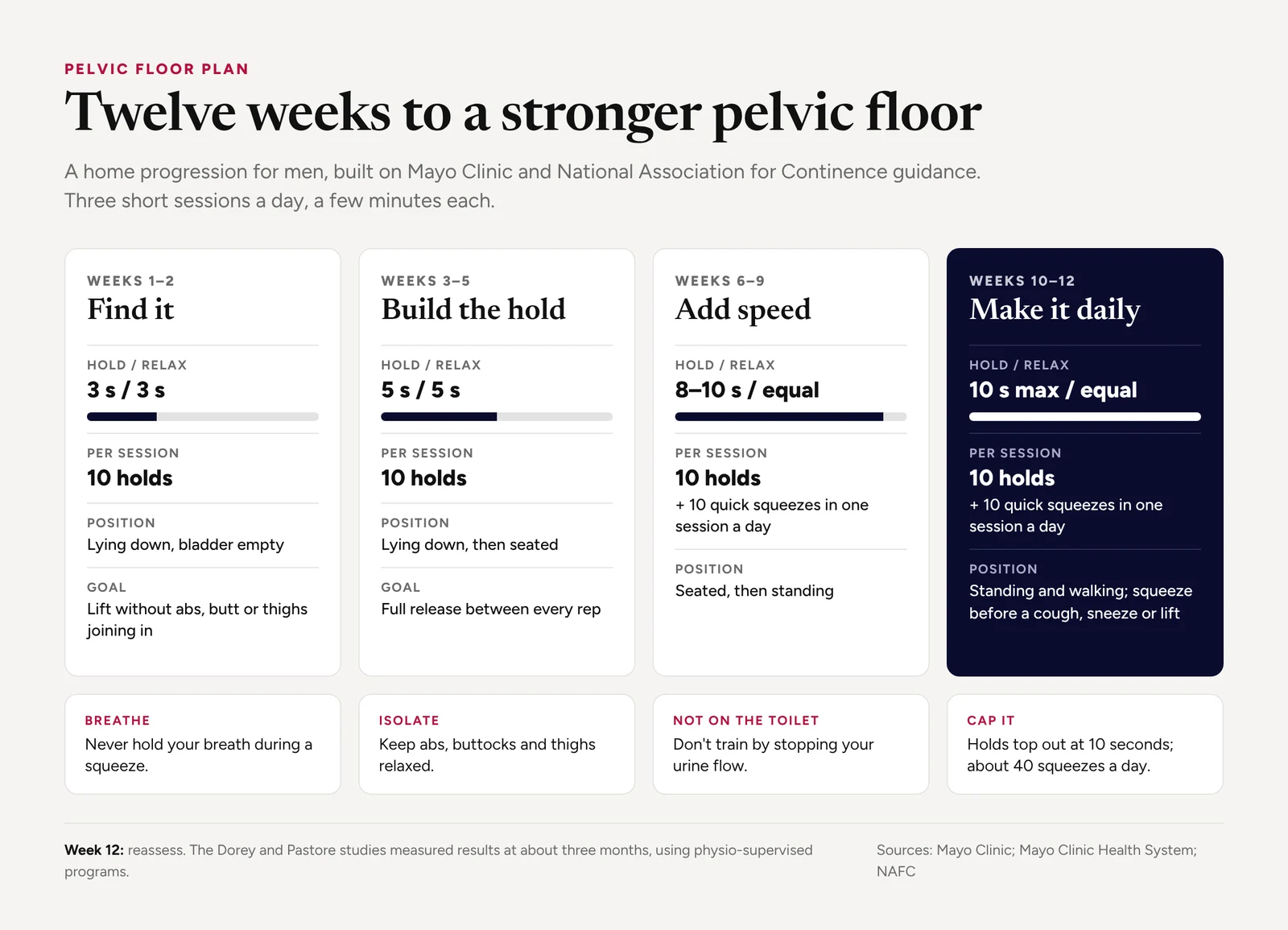
The instructions below follow guidance from the Mayo Clinic, Mayo Clinic Health System and the National Association for Continence. They are a home routine, not the supervised programs from the trials, so if you are not sure you are doing it right after a few weeks, a pelvic floor physiotherapist can check with biofeedback.
- Find the muscle. Imagine stopping yourself from passing gas, or stopping your urine midstream. That inward-and-upward lift is it. Another check: lie down, put a hand on the perineum (the strip between scrotum and anus) and feel for a slight lift when you squeeze.
- Start lying down. It is the easiest position to isolate the muscle. Empty your bladder first.
- Squeeze and hold for 3 seconds, then relax for 3 seconds. Let the muscle drop fully before the next one.
- Do 10 reps, three times a day. Mayo suggests working up to 10–15 per set.
- Build the hold toward 10 seconds over several weeks, with an equal rest. Mayo Clinic Health System advises against going past 10-second holds, as longer can tire the muscle.
- Add quick squeezes. Once long holds feel controlled, add sets of fast contract-and-release reps. These train the quick-reacting fibers.
- Move up to sitting, then standing, then walking. Gravity makes it harder, which is the point.
The mistakes that waste the effort
- Holding your breath. Breathe normally through every rep.
- Squeezing the wrong things. If your abs, butt or thighs tighten, you are cheating the target muscle. Put a hand on your stomach to check it stays soft.
- Doing them while you pee. Stopping urine is a way to find the muscle once, not a training method. Mayo warns that interrupting the flow can raise the risk of a bladder infection.
- Rushing. Ten slow, clean reps beat 50 sloppy ones.
- Overdoing it. Advice on volume varies between sources, but more is not automatically better. If you feel achy or the muscle feels tight all the time, cut back.
- Quitting at week three. Mayo says results may take a few weeks to a few months, and the continence group says three to six months. The trials ran three months or longer.
Breathing: the dial you can actually reach
Your nervous system runs two programs. The parasympathetic side, sometimes called rest and digest, is the main driver of erections. The sympathetic side, the fight-or-flight one, plays the leading role in ejaculation. That is basic physiology, per the same 2015 review, and it helps explain why an anxious, revved-up state is bad news on both fronts.
Slow breathing is one of the few ways to nudge that balance on purpose. A 2018 systematic review in Frontiers in Human Neuroscience looked at breathing slower than 10 breaths a minute in healthy people. It found higher heart rate variability, a marker of parasympathetic activity, along with reports of more relaxation and less anxiety and arousal. Here is the honest caveat: that review covered 15 studies in healthy volunteers, and none of the evidence in this article tested breathing as a stand-alone treatment for ED or premature ejaculation. It is a plausible tool with a sensible mechanism, not a proven fix.
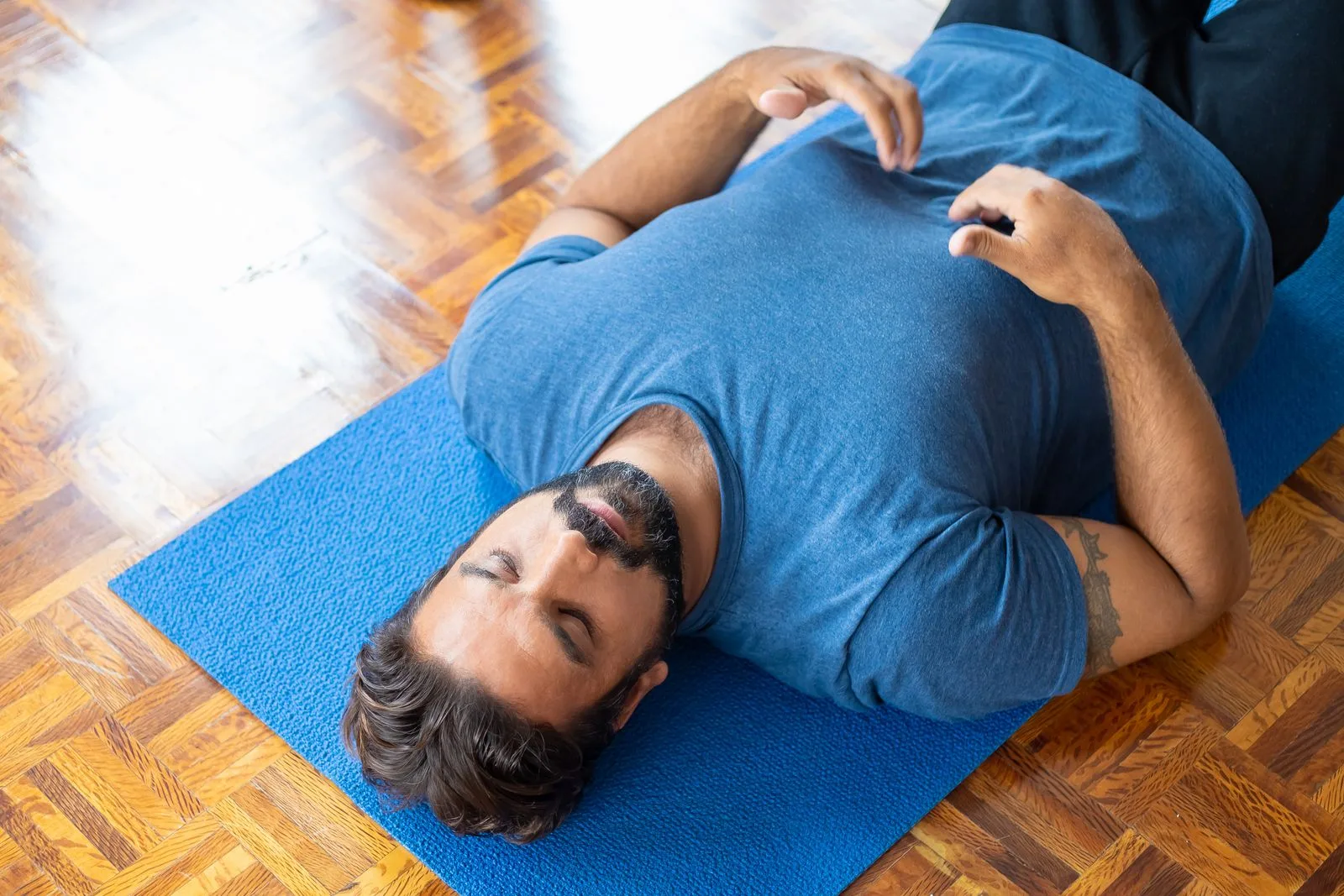
Diaphragmatic breathing is simple. Lie on your back with one hand on your chest and one on your belly. Inhale through your nose for about four seconds so the belly hand rises and the chest hand barely moves. Exhale for about six seconds. That is six breaths a minute. Practice five minutes a day when nothing is at stake, so it is automatic when something is.
During sex, notice when your breathing goes fast and high in the chest, and slow it for a few breaths. If you clench everything as arousal climbs, letting the belly and pelvic floor soften on the exhale is the opposite move. If your arousal habits were built on a very tight solo grip, the issue may be partly conditioning; our piece on the death grip research covers that.
Why the supplement aisle is the wrong aisle
In 2020, urologists at the University of Miami looked at the 16 most popular testosterone boosters and 16 most popular ED supplements sold by big US online retailers, including Amazon and Walmart. They used 37 ingredients between them, led by tribulus, tongkat ali, zinc, L-arginine and yohimbine. Not one whole product had a published randomized trial behind it. Only 19% of the ingredients earned the top grade for consistent positive evidence, and 68% landed in the bottom grades for contradictory, negative or missing evidence.
The bigger issue is what is sometimes in the bottle that is not on the label. The FDA has repeatedly flagged “sexual enhancement” products containing hidden sildenafil or tadalafil, the active drugs in Viagra and Cialis. In December 2023 it sent Amazon a warning letter over seven such products bought on the site, sold as energy supplements and, in one case, honey. The FDA warns that these hidden ingredients can interact with nitrates such as nitroglycerin and drop blood pressure to dangerous levels. Men with diabetes, high blood pressure, high cholesterol or heart disease are most at risk, and those conditions share risk factors with ED.
Put plainly: a “natural” pill that works suspiciously well may be working because it contains an unlabeled prescription drug at an unknown dose. If you want a PDE5 inhibitor, get one from a doctor who knows what else you take.

See a doctor if
- Erections are failing regularly and you are under 50. In the Mayo Clinic study, ED in men in their 40s was tied to a sharply higher rate of later coronary artery disease. Ask about blood pressure, cholesterol, blood sugar and heart risk, not just a prescription.
- You snore loudly, gasp at night, or wake up wrecked. These are the NHS’s listed signs of sleep apnea, which can be serious if left untreated.
- You take nitrates or have heart symptoms. Skip every “enhancement” product and talk to your doctor before any ED drug.
- Premature ejaculation is causing distress and 12 weeks of training has not shifted it. Medication such as SSRIs is the standard treatment, as the Pastore paper notes.
- You cannot find the muscle, or it hurts. A pelvic floor physiotherapist can confirm technique with biofeedback, as in the Dorey trial.
- Desire, energy and mood have all dropped. A blood test beats guessing from a supplement label.
Sleep, cardio, an unseen muscle and a slower exhale will never get a launch party. They are the things here with studies attached, and they improve the rest of your life while they work on the part you care about tonight. To put the new control to use, try our guide to bringing a toy into bed.
Quick answers
How long before Kegels make a difference?
Give it at least 12 weeks of consistent practice. Both the Dorey and Pastore studies measured results at about three months, and continence groups say three to six months for full effect. Once you see gains, keep a maintenance routine of a few sets a week; Mayo advises making the exercises a permanent habit to hold the benefit.
Can I do pelvic floor exercises at my desk or in the car?
Yes, once you can isolate the muscle lying down. A Mayo Clinic Health System physical therapist prefers dedicated quiet sets so you focus on form. Mayo also suggests a squeeze just before coughing, sneezing or lifting.
Will pelvic floor training make me last longer if I don’t have premature ejaculation?
The studies here did not test that. The Pastore study enrolled men whose baseline was a minute or less. Better awareness of the muscle may help with control generally, but none of these trials measured men already in the normal range.
Does napping make up for a short night?
The research here does not answer that. The Leproult study looked at a week of sustained five-hour nights, not naps, so the safest target is still the CDC’s seven or more hours on a regular schedule. A nap is a patch, not a plan.
Is L-arginine or another single ingredient worth trying?
The Miami review found that a minority of supplement ingredients had consistent positive trial evidence, but finished products had none, and dose and purity are not guaranteed. Talk to a doctor or pharmacist first, especially if you take blood pressure medication or nitrates, so they can check for interactions.